


 中文简体
 English
 한국어
 日本語
 русский
 Español
 عربى
Industry News
Home / News / Industry News / The Best Way to Cook Salmon: Heat, Timing, Moisture, and the Right Pan
Nov 17, 2026
Content
Salmon goes from silky to chalky in about ninety seconds. Anyone who has watched a fillet release a pool of white albumin into a hot pan knows the feeling: the fish was fine a moment ago and now it is dry, tight, and slightly rubbery at the edges. The best way to cook salmon is therefore not a secret ingredient or an eleven-step marinade. It is a repeatable heat strategy: dry the surface, keep the cooking medium moderate, and pull the fillet two or three degrees before it reaches the texture you actually want.
That single sentence solves most of the problems home cooks bring to us when they test samples in our kitchen appliance workshop. A wet fillet cannot brown, because the surface water has to evaporate before the protein can react with the pan. Until that happens, the fillet is effectively steaming, and steaming at a high temperature is the fastest route to a dry result. Patting the fish with paper towel for twenty seconds is not a garnish step; it is the difference between a golden crust and a grey, weeping surface.
Thickness matters just as much as technique. A tail piece at 1.5 cm and a centre-cut fillet at 4 cm cannot share a timer. Measure the thickest point with a ruler or the tip of an instant-read probe, then treat every centimetre of thickness as roughly four minutes of gentle contact heat. If you own a thermometer, use it. If you do not, learn the touch test: medium-rare salmon feels springy but not firm, and the flakes separate only when you press with a fork, not when you look at it.
Skin is an asset, not a nuisance. Skin-on fillets hold together better in a pan, insulate the flesh from direct contact heat, and give you a natural indicator of doneness, because the skin turns crisp and releases from the surface when the moisture underneath has driven off. Removing the skin removes your best safety buffer.
Cooking time is a guess. Core temperature is a measurement. Salmon is a fish with relatively little connective tissue, so the window between "silky" and "chalky" is narrow and it is defined almost entirely by how far the centre gets. The table below lists pull temperatures, meaning the reading you take while the fish is still in the pan or oven, plus the final temperature after a short rest.
| Doneness | Pull at core | After 3-minute rest | Texture | Typical use |
|---|---|---|---|---|
| Very soft | 44 to 46 °C | 46 to 48 °C | Jelly-soft centre | Low-temperature oven, sashimi-grade fish only |
| Medium rare | 48 to 50 °C | 50 to 52 °C | Silky, large soft flakes | Pan-searing, low oven roasting |
| Medium | 52 to 54 °C | 54 to 56 °C | Moist, clean flakes | Electric grill pan, baking, air frying |
| Medium well | 56 to 58 °C | 58 to 60 °C | Firm, noticeably less juicy | Thick steaks, buffet holding |
| Well done | 60 to 62 °C | 63 °C | Dense, dry at the edge | Catering and food-safety-driven service |
The 63 °C line is the reference point most food-service operators work to, and if you are cooking for a large group, an elderly guest, or a pregnant guest, it is the sensible target. For home cooking, most people find 52 to 55 °C far more enjoyable, and the difference in perceived moisture is dramatic rather than subtle. If you want the full breakdown of safe targets and the reasoning behind them, our own salmon internal temperature guide covers how those numbers translate into appliance thermostat settings.
Resting is not optional. A fillet pulled at 52 °C and cut immediately will lose juice onto the board. Give it three minutes on a warm plate, uncovered so the crust stays crisp, and the carryover heat finishes the centre for you.
Not every method punishes a thirty-second mistake equally. Some cooking media transfer heat slowly and forgive a late removal, while others push heat into the fish so aggressively that the margin disappears. The chart below compares the usable tolerance window of six common approaches, measured as the temperature span between a good result and an overcooked one.
Read the chart as a risk profile rather than a ranking of flavour. Steaming keeps the surrounding environment at roughly 100 °C, so the fillet can only approach that ceiling slowly and the cook has several minutes of usable reaction time. A thermostat-controlled electric grill pan sits in the middle of the range, which is exactly where most households want to be: fast enough to brown the surface, gentle enough that a two-minute delay does not ruin dinner.
Air frying and direct grilling sit at the other end. Both are legitimate techniques that produce excellent results, but they demand a thermometer and full attention, because the gap between underdone and overdone is only a couple of degrees. For a household that cooks salmon twice a week, this is the practical argument for a contact grill with adjustable temperature control rather than a single fixed-wattage plate.
Our own product development has followed this logic for years. When we design a grill pan or an electric baking pan, the thermostat range and the thermal mass of the plate matter more than any decorative feature, because the plate is what determines whether a cook can hold a stable 160 °C surface for six minutes.
If we had to name one approach that balances speed, crust, and forgiveness, it would be a skin-side-down sear on a thermostat-controlled electric grill pan. The plate holds heat evenly across its surface, the temperature dial removes the guesswork of gas flame adjustment, and a ridged or flat plate both work as long as the surface is genuinely hot before the fish goes on. Set the dial to a medium setting, in the region of 150 to 170 °C on the plate surface, and let it stabilise for five minutes.
Dry the fillet, salt it lightly, and place it skin side down away from you so any oil spatter travels forward rather than onto your wrist. Leave it alone. A fillet that is moved every thirty seconds never develops a crust, because the skin never stays in full contact long enough to dehydrate. Four to six minutes on the skin side for a 2.5 cm fillet is typical, then a flip for sixty to ninety seconds to finish the flesh side.
 Smokeless Series WT-ISG801 Electric Indoor Grill PanRemovable grill plate and drip tray suit salmon skin cooking, while six temperature levels and dual-fan filtration support indoor grilling.View Product →
A removable grill plate makes a real difference here, and not only for cleaning. Salmon skin leaves a fine residue of protein and fat that hardens as the plate cools, so being able to lift the plate into the sink within a few minutes keeps the non-stick surface intact for far longer. A drip tray underneath also catches the rendered fat that would otherwise burn and smoke, which is why indoor electric grill pans belong in apartment kitchens where a range hood may be weak or shared.
One caution: never preheat a coated plate above its stated maximum, and never plunge a hot plate into cold water. Thermal shock is the most common cause of coating failure we see in returned samples.
Baking is the method most people default to and the one most often overcooked, usually because the oven is set to 200 °C and the fish is left in for fifteen minutes "to be safe". A conventional bake at 180 °C works well for a single tray of fillets if you check at eight minutes. A low-temperature roast at 100 to 120 °C takes twenty to thirty minutes but produces a much more even result, with almost no grey band at the edge and a consistently silky centre throughout.
The low oven suits entertaining, because you can hold fillets at 60 °C for a short while without destroying them, and it suits thicker cuts such as a whole side or a 4 cm centre cut where a hot oven would cook the outside long before the middle is ready. Line the tray with parchment, drizzle a little oil, and add lemon slices under the fish rather than on top so the flesh does not steam under them.
Convection, or fan-forced, ovens need roughly 15 to 20 °C lower than the recipe states because the moving air strips moisture from the surface. If your oven has a fan setting and you have been following conventional temperatures, that single adjustment often explains why your salmon has been dry for years.
Steaming is underrated and slightly misunderstood. Because the cooking medium never exceeds about 100 °C, the protein sets slowly and the fish retains water that a hot pan would drive off. A 2 cm fillet steams in six to eight minutes, and the result flakes into large, glossy pieces that suit salads, rice bowls, and cold platters where a crisp crust would actually be a distraction.
The limitation is obvious: no browning, no Maillard flavour, and no crisp skin. Steaming also cannot rescue a fillet that has already been salted heavily, because there is no evaporation to concentrate the surface. If you want both, steam first and then finish the skin side in a hot pan for forty seconds, which is a technique worth knowing for thick steaks.
Equipment choice matters more than people expect. A 304 stainless steel steamer with a tight-fitting lid keeps the steam dense and the temperature stable, while a loose lid allows the water to boil off and the temperature to drop. Bamboo steamers are excellent for aroma but absorb fish odour, so keep a separate one for fish if you steam often.
An air fryer is a small convection oven running at high speed, and it will cook salmon in eight to ten minutes. The trade-off is that the moving hot air removes surface moisture quickly, so the margin for error shrinks to roughly three degrees. Preheat the basket, brush the fillet with a thin film of oil, and place it skin side down so the skin shields the flesh from the strongest airflow.
 WT-AF201 4-in-1 Compact Glass Air FryerGlass containers and four cooking modes let you monitor food without opening the basket, while nesting parts and dishwasher-safe pieces suit small kitchens.View Product →
A glass-walled air fryer is genuinely useful for this kind of cooking, because you can watch the surface colour change without opening the drawer and losing heat. Opening the basket mid-cook is one of the most common reasons air-fried salmon comes out uneven: every time you pull the drawer, the temperature drops and the timing you planned no longer applies.
Set 180 °C for a 2 cm fillet and start checking at seven minutes. If the skin is not crisp enough at the end, give it ninety seconds more rather than raising the temperature, because a sudden jump will cook the outside before the centre catches up. Salmon steaks with bone work better in an air fryer than thin tail pieces, which dry out almost immediately.
Direct grilling gives salmon the most flavour and the least forgiveness. The surface temperature of a hot grate can exceed 250 °C, which means the outside is done long before the centre is. The professional answer is to work with a two-zone setup, searing over the hot side for two minutes per side and finishing over indirect heat with the lid closed.
Oil the grate, not the fish. A wet, oiled fillet slips and tears; a dry fillet on an oiled, preheated grate releases cleanly when it is ready. If the fish sticks, it is not ready, and forcing it will leave the skin behind. Skewering thick steaks sideways also helps them hold shape on a grate.
Indoor electric grills solve the weather problem and the smoke problem at once, but they work differently: the plate contact transfers heat faster than open air, so a fillet that would take five minutes on an outdoor grate may take four. Treat any new grill as a calibration exercise for the first two cooks and record the settings that worked.
Two pans set to the same dial number can behave completely differently, and the reason is thermal conductivity plus wall thickness. Aluminium spreads heat quickly but is soft. Cast iron holds heat but is heavy and slow to respond. Magnesium aluminium alloy, which we work with daily, sits in an interesting middle position: it is light, it conducts heat evenly across a thin cast section, and it reaches temperature fast, which shortens preheating time and reduces the hot spots that cause one end of a fillet to overcook.
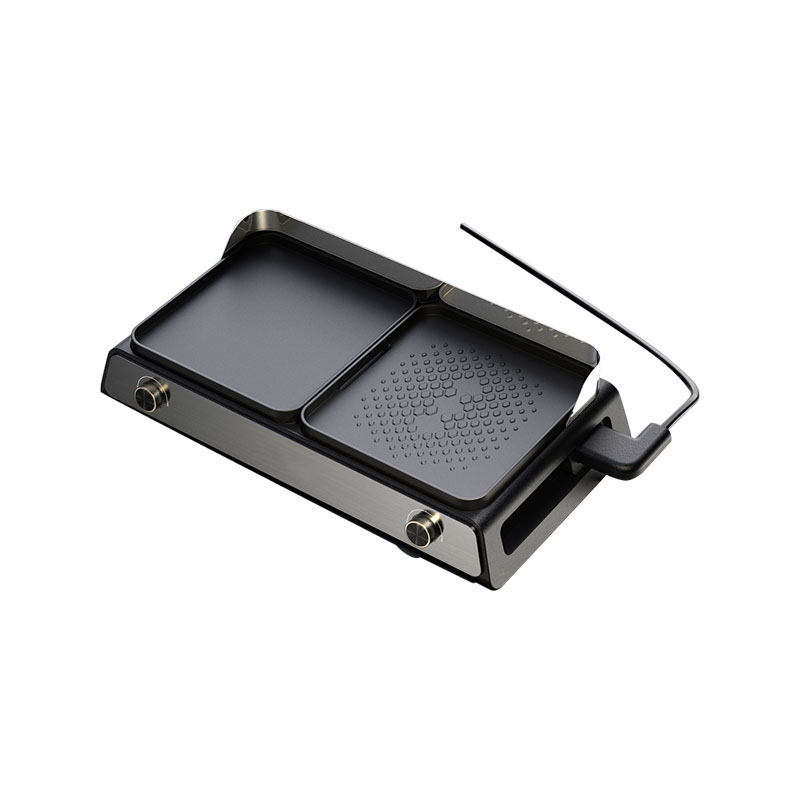 Magnesium Alloy Dual-Zone Grill PanDual independent plates and adjustable heat support cooking different foods together, with magnesium alloy construction and non-stick coating for even grilling.View Product →
The practical consequence for salmon is a more even surface colour and less need to rotate the fish halfway through. The practical caution is that a light, fast-heating plate also cools faster when cold fish lands on it, so preheat a little longer than the dial suggests and avoid moving the fillet around. Coated surfaces should stay within the manufacturer's stated maximum, usually well below the temperatures a bare cast-iron pan can take.
For buyers evaluating cookware, the useful question is not "which metal is best" but "which metal suits the cooking behaviour the product is sold for". A grill pan marketed for fish wants even, moderate heat and a coating that releases cleanly. A pan marketed for steak wants thermal mass. These are different design briefs, and they should produce different specification sheets.
Salt is the single most effective improvement after temperature control, and the timing changes the outcome. Salting a fillet forty minutes before cooking draws moisture out, dissolves the salt, and reabsorbs it as a concentrated brine, which seasons the interior and slightly firms the surface for better browning. Overnight dry-brining in the refrigerator goes further and produces a denser, more savoury result, but pat the surface dry again before it hits the pan.
Acid marinades need limits. Citrus, vinegar, and wine begin to denature the surface protein within twenty minutes, turning the outer few millimetres opaque and mushy. Keep wet marinades to thirty minutes, or use them as a glaze applied in the last two minutes of cooking. Sugar-heavy glazes burn at pan temperatures above 180 °C, so apply them late or cook the fillet at a lower setting.
Fat carries flavour and improves release. A thin brush of oil on the fish is enough; a flooded pan simply steams the surface. Herbs and aromatics belong under the fish or in the cavity of a whole side, not piled on top where they insulate the crust from the heat.
Across hundreds of test cooks, the same six errors appear again and again regardless of the equipment used.
None of these require new equipment to fix, which is encouraging. Most of them are attention problems rather than skill problems.
A non-stick or ceramic coating degrades for predictable reasons: abrasive scrubbing, thermal shock, and overheating. Let the plate cool to a comfortable temperature before washing, use a soft sponge with warm soapy water, and skip the metal scouring pad entirely. Fish residue is mostly protein and fat, both of which soften in warm water within a couple of minutes, so patience replaces scrubbing.
Thermostats also drift over time, especially in appliances used daily at high settings. If your grill pan starts browning faster than it did a year ago, the dial may no longer match the plate temperature; a cheap infrared thermometer will tell you in ten seconds. In our factory, thermostat endurance is one of the routine checks we run on every heating appliance, and coating corrosion resistance is verified with salt spray testing before a model is released.
Storage matters too. Stacking pans without a protective sheet scratches coatings, and those scratches become the place where a coating eventually lifts. A folded cloth between pans is the cheapest insurance available.
If you are sourcing electric grill pans, steamers, or air fryers for a retail programme, the salmon cooking experience translates directly into specification language. Buyers who do not cook the category themselves tend to over-specify wattage and under-specify temperature stability, and the result is a product that looks competitive on a carton but disappoints in a test kitchen.
Four items belong on every brief. First, the usable thermostat range and the tolerance at the low end, because fish cooking happens at moderate settings rather than maximum power. Second, the plate material and coating system, including the maximum surface temperature the coating supports. Third, cleanability: whether the plate detaches, whether the drip tray is dishwasher safe, and how the seam between plate and housing is sealed. Fourth, packaging and drop resistance, since a well-designed pan that arrives dented is a return waiting to happen.
For importers and own-brand programmes, the more useful question is whether the manufacturing partner can hold these tolerances across an annual volume, not whether they can build one sample. Our team at Victor Electric Appliance Technology Co., Ltd. works with brand owners and wholesalers on exactly this basis, from mould development through to finished appliance assembly, with roughly 60 percent of output exported and an average lead time around 45 days. The ODM and OEM cooperation model explains how a project moves from brief to tooling to mass production.
For most households, a moderate-temperature sear on a thermostat-controlled electric grill pan followed by a short rest gives the best balance of crust, moisture, and repeatability. Low oven roasting is equally good if you prefer hands-off cooking. Both methods share the same principles: a dry surface, a moderate heat source, and removal 2 to 3 °C before target.
Yes, in a pan or on a contact grill. The skin insulates the flesh, gives you a visual cue for release, and produces a crisp texture that most people enjoy. In an air fryer, skin side down also shields the flesh from the strongest airflow.
A 2.5 cm fillet typically needs four to six minutes skin side down at a 150 to 170 °C plate temperature, then sixty to ninety seconds on the flesh side. Thinner tail pieces may need half that time, so always check the core temperature rather than the clock.
Many chefs and home cooks prefer 50 to 55 °C for texture, but food-safety guidance generally points to 63 °C. The right target depends on your audience. For guests with weakened immunity, pregnancy, or young children, use the higher figure and accept the firmer texture.
You need very little. A thin film improves release and heat transfer, and fat-soluble flavours carry better. A flooded pan is counterproductive because the fish ends up shallow-frying rather than searing, and the surface never forms a crust.
You can, but expect a longer cook and a wider grey band around the edges. Thawing overnight in the refrigerator produces a noticeably better result, and it lets you dry and salt the surface properly, which is where most of the flavour and texture improvement comes from.
That is albumin, a protein that squeezes out when the flesh is heated too fast or too far. It is harmless but signals overcooking or a heat source that is too aggressive. Lower the setting, dry the surface, and pull the fillet earlier.
Reheating will always firm the flesh, so keep it brief. A covered pan over low heat for two minutes, or thirty seconds in a microwave at reduced power, preserves more moisture than a second full cook. Alternatively, flake it cold into a salad, where the texture change no longer matters.
If you take one habit away from this guide, make it the thermometer. Everything else, from pan choice to marinade, is a refinement on top of a simple truth: salmon is finished by temperature, not by time. A dry fillet, a moderate heat source, and a pull temperature two or three degrees below target will produce a better result than an expensive piece of equipment used blindly. Whether you sear it on a ridged indoor grill, roast it slowly in a low oven, or steam it gently for a cold platter, the fish will tell you when it is ready if you are willing to measure rather than guess.
Follow our social media to learn more about our updates


+86-13805815092

No. 11 Beihai Road, Xinqi Street, Beilun District, Ningbo City, Zhejiang Province, China
