


 中文简体
 English
 한국어
 日本語
 русский
 Español
 عربى
Industry News
Home / News / Industry News / Coq au Vin Recipe: Reliable Wine Ratios, Braising Times and Pan Choices

Nov 09, 2026
Content
A pot of coq au vin fails in two predictable ways: the chicken is stubborn and dry because the liquid boiled instead of simmered, or the sauce turns thin and bitter because too much acidic wine went in and nothing was reduced to balance it. Both faults come from numbers, not from talent. Get two numbers right and this coq au vin recipe behaves like a reliable production process rather than a weekend gamble: roughly 600 to 700 ml of braising liquid per kilogram of chicken, and a liquid temperature that stays near 85 to 90 degrees Celsius for the whole braise.
Everything else in this article hangs off those two figures. We will go through the ingredient ratios that keep the sauce round instead of sharp, the stage-by-stage timings, the vessel decisions that decide whether the sauce reduces evenly, and the faults that show up most often in home kitchens and in contract kitchens cooking the same dish two hundred times a week. We will also look at the hardware side, because the pan and the heat source do more of the work here than most cooks admit, and because Victor Electric Appliance Technology Co., Ltd. builds exactly the kind of cooking hardware that this dish leans on.
Before the method, here is the short version. It is the same set of numbers we use when writing specifications for a pan or a thermostat, because a braise is a temperature control problem dressed up as a cooking problem.
If you only remember one thing: the sauce should taste of wine that has been cooked, not of wine that has been warmed. Alcohol boils at around 78 degrees Celsius, so a gentle braise does drive it off, but a meaningful fraction can survive an hour of low simmering. That is one reason a long, quiet braise tastes rounder than a fast one.
The dish is decided by liquid volume per kilogram of meat and by a simmer that never breaks, not by the price of the wine.
Coq au vin started as a way to make an old bird edible. A mature rooster is tough because its connective tissue is dense with collagen, and collagen only turns into soft gelatine under two conditions at once: enough heat, and enough time with moisture. Push the heat too high and the muscle fibres contract and squeeze out water faster than the collagen can break down, which is why a boiled coq au vin is both dry and stringy at the same time.
Red wine brings three things to the pot: water, acid, and aroma compounds. The acid is useful in small amounts because it helps break down surface proteins and brightens a heavy sauce. Too much of it, or acid from a thin, sharp wine, and the sauce reads sour. Wine also carries tannin, and tannin from an aggressively oaked bottle concentrates as the sauce reduces, which is the most common reason a home-made coq au vin tastes bitter at the end.
That is why the ratio matters more than the label. Two parts wine to one part stock gives a sauce with a clear wine character and enough body to coat a spoon. Drop to one part wine to one part stock and you get a milder, more crowd-friendly version that holds up better when the dish has to be reheated in quantity. Either works, but pick deliberately.
Chicken thighs are safe at 74 degrees Celsius, but they are pleasant at 80 to 85 degrees Celsius, held there for half an hour or more. In that band the collagen keeps converting and the meat stays juicy. Above 95 degrees Celsius the sauce emulsifies fat and protein into a cloudy suspension, the wine turns harsh, and the meat fibres tighten. An inexpensive clip-on thermometer in the pot does more for this recipe than any additional ingredient.
A coq au vin that tastes sharp or bitter is almost always a sauce that reduced too hard with too much tannic wine, not a sauce that needed more salt.
The table below is built around a 1.5 kg bird, which feeds four generously or six modestly with sides. The ratio column is the part worth keeping, because it scales cleanly when you double or quadruple the batch.
| Ingredient | Amount | Ratio or note |
|---|---|---|
| Bone-in chicken thighs and drumsticks | 1.5 kg | Skin on; 6 thighs plus 4 drumsticks is a typical split |
| Dry red wine | 750 ml | Two parts wine to one part stock by volume |
| Chicken stock | 250 to 375 ml | Added only after the wine has reduced by about a third |
| Smoked bacon or lardons | 150 g | About 10 percent of the meat weight for seasoning and fat |
| Pearl onions | 300 g | Blanched for 30 seconds to slip the skins |
| Button mushrooms | 250 g | Dry-fried first, then buttered at the end |
| Garlic | 4 cloves | Smashed, removed before serving |
| Tomato paste | 1 tablespoon | Fried with the aromatics to cut acidity |
| Plain flour | 2 tablespoons | Dusted on the chicken, or worked into beurre manie |
| Butter | 30 g | Finish only; do not use it for the sear |
| Thyme, bay leaf, peppercorns | 4 sprigs, 2 leaves, 8 corns | Bundled so they lift out cleanly |
| Cognac (optional) | 60 ml | Flambe or reduce before the wine goes in |
A dry, medium-bodied red with moderate tannin and no heavy oak influence is what you want: a basic Burgundy-style Pinot Noir, a light Cabernet Franc, or a young Syrah blend. Avoid anything described as oaky, jammy or high in alcohol, because those traits concentrate rather than soften. Wine that is unpleasant enough to spit out will not improve in the pot; the old saying about only cooking with wine you would drink is roughly accurate, though it does not mean you need an expensive bottle.
Smoked bacon is a shortcut; traditional lardons are unsmoked and saltier. Smoked bacon pushes the sauce toward a heartier, almost winter-stew profile, which most family tables prefer. If you use smoked, blanch it for two minutes first and cut the added salt in the recipe by about half, since the cure carries a lot of sodium.
Blanching smoked bacon for two minutes and halving the added salt is the single cheapest improvement most cooks can make to this dish.
The method below assumes a heavy 28 cm braiser with a lid. If you are cooking on an induction hob, check that the base is flat and magnetic before you start, because an uneven base creates a hot ring that scorches the wine solids within minutes.
Combine the chicken, wine, thyme, bay and peppercorns in a non-reactive container and refrigerate for 2 to 12 hours. The marinade does not penetrate deeply, but it seasons the surface and starts to soften the skin. If you are short of time, skip it entirely and add an extra 15 minutes to the braise; the difference is noticeable but not fatal. Pat the pieces thoroughly dry before searing, because wet skin steams instead of browning.
Render the bacon in the dry pot over medium heat until the fat runs and the pieces crisp, then lift them out. Sear the chicken skin-side down in the bacon fat, in batches, without crowding. You are looking for a deep golden surface, roughly 4 to 5 minutes per side, and you should hear a steady sizzle rather than a spitting roar.
For larger batches, or when the pot is already full of sauce base, an electric grill pan with a removable plate handles the browning stage faster and keeps the braiser free. Batch searing is where most home cooks lose 15 minutes, so a second heat source genuinely helps.
 Smokeless Electric Grill Pan with Removable Grill PlateA second indoor heat source for batch searing, with a removable non-stick plate, six temperature levels and dishwasher cleaning subject to care instructions.View Product →
Lift the chicken out, pour off all but two tablespoons of fat, and add the pearl onions and mushrooms. Cook them hard for 4 minutes so they colour rather than weep, then set them aside with the bacon. These go back in at the end so they keep their shape.
Lower the heat, add the garlic and tomato paste, and stir for 60 seconds until the paste darkens. Dust the chicken with flour, return it to the pot, and turn each piece so the flour cooks into the fat. Pour in the wine in two stages, scraping the base between additions. This deglazing step is where the colour of the finished sauce is set, and skipping the scrape leaves pale, floury patches.
Bring the wine to a bare simmer, add the stock and the herb bundle, then return the chicken skin-side up. The liquid should come about two-thirds of the way up the pieces, not cover them. Cover with the lid slightly ajar or with a sheet of baking paper pressed onto the surface, and hold at 85 to 90 degrees Celsius for 55 to 70 minutes. Check at 45 minutes; if the meat is already yielding at the bone, you are done early.
Lift the chicken out and keep it warm. Strain the braising liquid, skim the fat, and reduce over medium heat until it coats the back of a spoon, which usually takes 8 to 12 minutes. If it needs body, whisk in a beurre manie of equal parts soft butter and flour, or a teaspoon of cornflour slaked in cold water. Return the chicken, bacon, onions and mushrooms, warm through for 5 minutes, then stir in the butter off the heat and taste for salt. Add the parsley at the very end.
Keep the liquid at two-thirds of the height of the chicken and never let it cover the skin during the braise, or the crust you built in step two will dissolve.
Most of the frustration around this dish comes from misreading the clock rather than misreading the recipe. The chart below separates passive waiting from hands-on work, so you can decide whether the classic version fits a weeknight or belongs to a Sunday.
Note that the passive stages are the ones that tolerate interruption; the active stages do not.
Two-thirds of the total is unattended, which is why the dish suits batch production and advance cooking far better than it suits last-minute service. That matters for equipment design: a pan that holds a steady 85 to 90 degrees Celsius without a cook standing over it is worth more here than a pan that heats faster.
It also explains why thermostatic control has become a practical feature rather than a marketing one. An electric grill pan with a temperature dial, or a cooking pot paired with a probe, removes the main variable that ruins a braise. In our own product development work, the specification we argue over most is not peak wattage but the width of the temperature band at low settings, because that is the setting a braise actually uses.
For anyone planning to cook this in volume, the practical conclusion is to consolidate the active stages: sear everything in one pass on a wide flat surface, then move it to the braising vessel and let the thermostat carry the next hour.
Roughly two-thirds of a coq au vin is unattended time, so the equipment that matters is the one that holds a low temperature steadily, not the one that heats fastest.
Any vessel wide enough to hold the chicken in one layer with a tight lid will work, but the material changes how much attention the braise needs. Thick cast material evens out hot spots; thin material creates a hot ring at the burner circumference and a cold centre. On a gas hob the difference is forgiving, on induction it is not.
| Vessel type | Heat behaviour | Weight and handling | Best suited to |
|---|---|---|---|
| Enamelled cast iron braiser | Slow to change temperature, very even once hot | 4 to 6 kg, needs two hands | The classic long braise, oven finishing |
| Stainless steel with sandwich base | Fast response, but thin walls can scorch wine solids | 2 to 3 kg | Weeknight version and reduction work |
| Magnesium-aluminium alloy pan | Light, rapid and even heat on flat electric plates | Usually under 1.5 kg | Searing and dry cooking, not long acidic braises |
| Electric pan with thermostat | Holds a set band, no hob required | Fixed on the counter | Small kitchens and repeatable batch cooking |
Alloy cookware has a real advantage in weight and warm-up speed, which is why magnesium-aluminium alloy bodies show up in grill pans and portable cooking appliances. Those same properties make alloy less ideal for a 60-minute simmer in acidic wine unless the cooking surface carries a proper coating, so we generally recommend alloy pans for the searing and finishing stages of this recipe and a coated or stainless vessel for the braise itself. That is a materials decision, not a brand one.
Match the material to the stage: light alloy for the sear, a coated or stainless vessel with a heavy flat base for the acidic braise.
The faults below account for most of the disappointing pots we hear about. Each one has a cause you can see in the pan and a fix that does not require starting over.
| Fault | Usual cause | Fix |
|---|---|---|
| Sauce tastes sharp or sour | High-acid wine and insufficient reduction of the alcohol | Simmer uncovered 10 minutes, add 1 teaspoon honey or a knob of butter, and a pinch of salt |
| Sauce tastes bitter | Heavily oaked wine reduced too far, or scorched flour | Dilute with 100 ml stock, add 1 teaspoon cream, and avoid scraping any dark base |
| Sauce is thin and watery | Lid too loose, or a cold pot during the braise | Strain, reduce by a third, then thicken with beurre manie |
| Chicken dry and stringy | Liquid boiled rather than simmered | Nothing restores it fully; slice and serve in the sauce, and use a thermometer next time |
| Cloudy, greasy sauce | Fat emulsified by hard boiling | Chill, lift the solid fat cap, then reheat gently |
| Mushrooms and onions collapsed | Added at the start instead of the finish | Cook a fresh batch and fold in just before serving |
Two of these faults are worth preventing rather than fixing. Bitterness from an oaky wine cannot be undone cleanly, and dry chicken cannot be rehydrated. Everything else is recoverable within ten minutes.
Thin sauce and cloudy sauce are both fat-and-heat problems, so correct them by chilling, skimming and reheating gently rather than by adding more flour.
The sauce is the point, so the starch should be a vehicle rather than a competing flavour. Mashed potato, buttered noodles, boiled new potatoes, or thick slices of sourdough all work. Steamed waxy potatoes are the lightest option and the easiest to hold for a crowd, and they can be cooked in the same session without a second hob.
A three-tier stainless steamer handles that job well: potatoes on the bottom tier, green beans or cabbage above, both done in about 18 minutes with no extra fat.
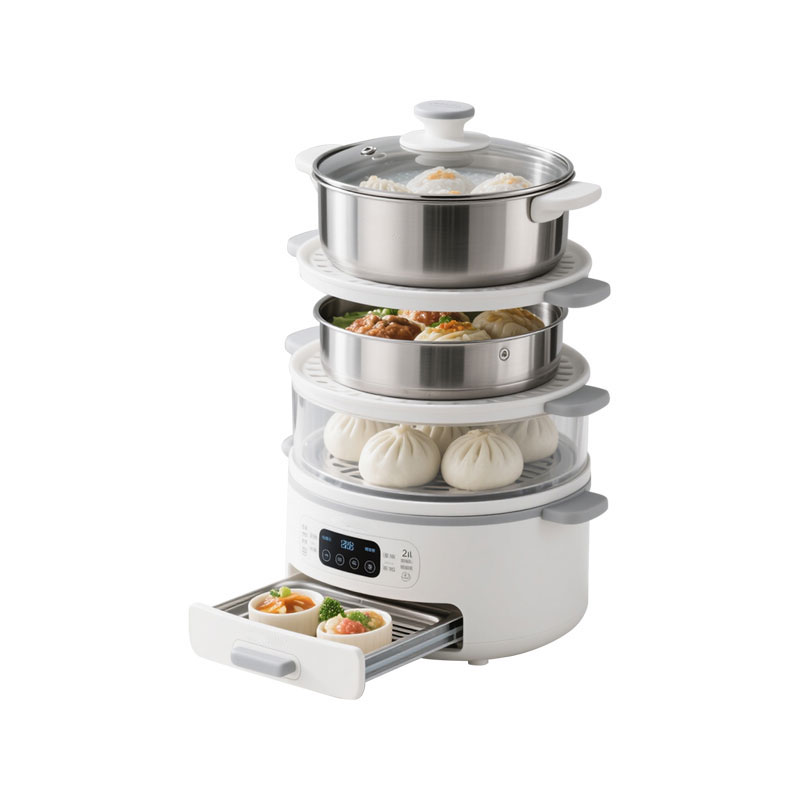 Three-Tier 304 Stainless Steel Steamer PotSteam potatoes and vegetables on separate tiers while the lower section handles boiling or soup, with 304 stainless construction and anti-dry-burn protection.View Product →
For contrast, a sharply dressed salad with mustard vinaigrette cuts through the fat, and pickled shallots or cornichons do the same job with less work. Avoid anything heavily cheesy or creamy alongside, because the sauce already carries richness.
Two thighs per person is a generous restaurant portion at around 300 g of bone-in meat. In a buffet setting, one thigh plus a drumstick with a generous ladle of sauce holds better under a heat lamp than a single large piece, because the smaller pieces reheat more evenly.
Serve the sauce over the meat rather than under it, and keep the garnish of parsley and a little orange zest to the last second, since both fade within 20 minutes of plating.
Choose plain starches and sharp, acidic sides; anything creamy competes with a sauce that is already rich.
Coq au vin scales better than most braises because the active stages are short and the passive stage is forgiving. The rules that keep it consistent in volume are simple. Sear in a wide, flat pan rather than a deep pot so the pieces do not steam each other. Braise in batches no larger than a vessel that holds the chicken in a single layer. Cool and chill in shallow trays no deeper than 5 cm, because a deep container cools too slowly through the middle.
For a contract kitchen or a ready-meal line, the process usually becomes three separate operations: sear and chill the chicken, prepare and reduce the sauce base, then combine and finish on the day. That split lets a 45-minute finishing window replace a 3-hour cook, which is how most food service operations actually deliver this dish.
This is also where appliance specification starts to matter commercially. A pan that reaches braising temperature in 4 minutes instead of 9 saves roughly 5 minutes per batch, which compounds quickly across a shift. A thermostat band that holds within plus or minus 5 degrees Celsius reduces the number of pots that need rescuing. Ningbo Victor Electrical Technology Co., Ltd. has been building kitchen appliances since 2019 with an export share of about 60 percent, and average delivery times of roughly 45 days, which is the kind of cycle a buyer plans a season around.
Split the process into sear, sauce and finish; that separation, not a bigger pot, is what makes this dish viable at volume.
Buyers sourcing pans and electric cooking appliances for wine-braised dishes tend to ask the same five questions, and the answers are usually about tolerances rather than features.
On the fourth point, the useful evidence is not a certificate on a wall but a record of specific tests: coating abrasion cycles, salt spray hours on metal parts, glow wire testing on electrical components, drop tests on packaging, and life-cycle testing on hinges, lids and control knobs. A supplier that can show a test file with numbers, not just pass marks, is easier to keep in a programme for years.
Tooling is the other half of the conversation. A buyer who wants a distinctive pan profile, a specific handle angle or a branded lid needs mould and part processing capability behind the assembly line, not just a trading office. Ningbo Victor Electrical Technology Co., Ltd. runs a separate magnesium-aluminium mould and parts processing operation alongside its finished appliance lines, which is what makes small-batch shape changes practical rather than theoretical.
 Magnesium and Aluminium Alloy Mould Processing ServiceOEM/ODM mould and parts processing for custom pan profiles, with controlled cooling, wear-resistant coatings and five-axis milling for small-batch shape changes.View Product →
Finally, buyers should ask how the appliance behaves when the recipe goes wrong. A pan that tolerates a scorched base without delaminating, and a coating that survives a deglaze with wine at 90 degrees Celsius, is worth more than one with a marginally better warm-up time.
Ask for a temperature band, a flatness tolerance and a test file with numbers; those three documents predict performance better than any feature list.
Coq au vin improves overnight, which makes it one of the few dinner-party dishes you can finish the day before. Cool it quickly, ideally within 90 minutes of removing it from the heat, and refrigerate in a container no deeper than 5 cm. The fat will set into an opaque cap; lift it off in one piece and discard or keep a spoonful to finish the sauce.
Reheat gently on the hob at 70 to 75 degrees Celsius, covered, with a splash of stock to loosen the sauce. Microwaving works for single portions but heats unevenly around the bone, so stir halfway and let it stand for two minutes. Freezing is acceptable for the sauce and the meat separately; potatoes and mushrooms do not freeze well and should be cooked fresh.
Cool within 90 minutes, refrigerate shallow, and reheat at 70 to 75 degrees Celsius; those three habits protect both texture and safety.
Yes, but the balance changes. Replace the wine with 600 ml of unsalted stock plus 2 tablespoons of red wine vinegar and a tablespoon of cranberry or pomegranate juice for the fruit notes the wine would have supplied. Add the vinegar late, after reduction, so the acidity stays bright rather than cooking flat.
Two hours is enough to season the surface; twelve hours is the practical upper limit for thighs. Beyond eighteen hours the outer muscle starts to firm up and the result is a slightly rubbery edge. Keep the marinade refrigerated throughout, and never reuse it raw as a sauce without boiling it thoroughly first.
Almost always a combination of a heavily oaked wine and an aggressive reduction. Tannin and oak-derived compounds concentrate as water evaporates. Dilute with a little stock, add a teaspoon of cream or butter to round the edges, and choose a lighter, less oaky wine next time.
A heavy, wide braiser with a tight lid and a base matched to the burner. If you have induction, check the base flatness first; if you have a narrow hob, choose a vessel with taller walls so the liquid level stays deep enough to braise without covering the chicken.
You can, but reduce the wine by half first in a separate pan. Slow cookers trap moisture, so the sauce will not concentrate, and the result is often watery. Sear the chicken and vegetables on the hob before transferring, or the finished dish will lack depth.
The meat should yield when pressed near the bone and the juices run clear. A probe thermometer reading 80 to 85 degrees Celsius at the thickest part of the thigh is a reliable target; 74 degrees Celsius is safe, but the extra 6 to 11 degrees gives the texture this dish is known for.
Generally yes. Overnight the sauce settles, the fat separates cleanly and the seasoning spreads through the meat. Reheat gently and refresh with parsley and a small knob of butter to bring back the shine.
A light, dry, unoaked red at a modest price. For volume cooking, consistency between bottles matters more than quality, so choose a single supplier and a single style, and taste the reduced sauce before seasoning the whole batch.
Most FAQ answers come back to the same three controls: the wine style, the reduction level and the temperature band during the braise.
Victor Electric Appliance Technology Co., Ltd. designs and manufactures kitchen appliances for international buyers, covering coffee machines, waffle makers, grill pans, steamers, sandwich makers, air fryers and magnesium alloy cookware, alongside a separate magnesium-aluminium mould and parts processing business. If this article raised questions about a specific model, a coating specification or a private-label programme, the two routes below are the fastest way in.
The practical takeaway from the whole article is simple enough to act on tonight: weigh the chicken, measure the wine against the stock, keep the liquid under a simmer, and choose the pan for the stage you are cooking rather than for the whole recipe.
Follow our social media to learn more about our updates


+86-13805815092

No. 11 Beihai Road, Xinqi Street, Beilun District, Ningbo City, Zhejiang Province, China
