


 中文简体
中文简体 English
 한국어
한국어 日本語
日本語 русский
 Español
 عربى
عربىIndustry News
Home / News / Industry News / How to Choose the Best Grilling Tools Set for Outdoor Cooking That Lasts

Oct 12, 2026
Content
A European private-label buyer opened the first carton of a grill tool set in early September. Eight pieces, a carry bag, a hanging loop on every handle, and a clean inspection report. Everything looked correct. Three weekends later the same buyer was processing returns: the tongs had lost their spring, the turner had twisted at the neck, and the basting brush had shed silicone bristles onto a hot gas grate. None of those failures were random. They traced back to decisions that had been made months earlier at the specification table, where a 0.8 mm stainless body was accepted instead of 1.2 mm, a riveted pivot was approved instead of a welded one, and a handle rated to 180 °C was paired with a firebox that regularly reaches 260 °C.
That is the pattern behind most complaints about outdoor cooking tools. The set is not failing because it is cheap. It is failing because the specification never described what the tool would have to survive.
The best grilling tools set for outdoor cooking is not the one with the most pieces. It is the one where the steel grade, the joint construction, the heat isolation of the handle, and the edge geometry of every tool are defined in writing before production starts. A ten-piece set built to a loose specification will lose more customers than a six-piece set built to a tight one. This article looks at what belongs in a serious set, which measurements matter, how tools should match the cooking surface they are used on, and what wholesale and private-label buyers should demand from a supplier before committing to a container.
When procurement teams compare quotations for a grilling tool set, the first column they usually look at is the piece count. That is the least useful number in the document. Piece count is easy to inflate with a corn holder or a second fork, and it says nothing about whether the set will still be usable after twenty cooking sessions. The variables that actually decide quality are fewer and far more concrete.
Three of them dominate: the grade and thickness of the metal, the way the handle transfers or blocks heat, and how the working edge of each tool meets the surface it is used against. Get those right and the piece count becomes a marketing decision rather than an engineering one.
Stainless steel is a family, not a single material. A 304 grade resists corrosion well and is the standard choice for tools that will be washed repeatedly and left outdoors. A 430 grade is magnetic, easier to form, and cheaper, but it shows pitting sooner in coastal or humid conditions. Some suppliers mix the two without saying so, using 304 for the visible head of a turner and 430 for the shaft. The difference only becomes visible after a few months of use, which is well after the inspection window has closed.
Thickness matters just as much as grade. A turner blade at 0.8 mm flexes when it lifts a half-kilogram brisket and eventually bends permanently at the neck. A blade at 1.2 mm to 1.5 mm holds its shape. The same logic applies to tong arms: thin arms feel light in the hand, which buyers sometimes mistake for precision, but they deform when they grip a heavy joint of meat.
| Material or construction | Typical thickness or rating | Practical behavior outdoors | Main risk in volume production |
|---|---|---|---|
| 304 stainless, solid head | 1.2 to 1.5 mm | Holds shape when lifting heavy food, resists corrosion | Higher material cost, heavier shipping weight |
| 430 stainless, solid head | 1.0 to 1.2 mm | Adequate for light turning and basting | Pitting in humid or coastal storage |
| Mixed grade body and shaft | Varies | Looks correct at inspection | Uneven corrosion, hard to defend in a claim |
| Riveted pivot joint | Single or double rivet | Loose spring action after repeated heating cycles | High return rate, no repair path |
| Welded pivot joint | Continuous weld | Maintains tension longer | Requires tighter process control |
| Silicone handle grip | 180 to 230 °C | Comfortable, but fails if used over open flame | Melting complaints when rating is unclear |
A grill tool handle has two jobs that pull in opposite directions. It has to keep the user's hand cool, and it has to stay firmly attached after repeated heat cycles. Wood, silicone, and composite handles solve the first problem in different ways, but they solve the second problem only if the attachment method is correct.
Wood handles are pleasant to hold and look premium in photographs. They also absorb grease, crack when left in the rain, and are difficult to clean to food-contact standards in a commercial setting. Silicone sleeves are washable and heat-resistant up to a defined temperature, but that temperature must be printed on the packaging or the customer will eventually use the tool directly over a flame and complain when the sleeve deforms. Composite or glass-filled nylon handles sit between the two: dimensionally stable, dishwasher-safe, and less sensitive to humidity, though they feel less warm in the hand.
The attachment is where most field failures originate. A handle pressed onto a tang with a single screw loosens under expansion and contraction. A handle overmolded onto a full tang, or secured with a mechanical through-pin, holds far better. This is a small detail that rarely appears on a quotation sheet and almost always appears in return data.
Tools are used against a surface, and the surface has a shape. A turner with a flat, thin leading edge slides under a burger on a flat griddle. The same turner on a round kettle grate catches on the bars and tears the food. A shallow-angled edge with a slight bevel works better across both, at the cost of a little more manufacturing attention.
Forks need to be sharp enough to pierce but not so sharp that they scratch a coated surface. Basting brushes need bristles spaced closely enough to hold sauce without dripping into the fire. Grill brushes need a scraper edge that removes carbon without gouging the grate. None of these are difficult requirements, but they have to be written down. When they are not written down, each production batch interprets them differently.
A grilling tool set is only as good as its weakest specification. Define steel grade, thickness, joint type, and handle rating in writing, or the piece count will not protect you from returns.
A set that covers outdoor cooking properly does not need twenty items. It needs the right seven or eight, each built to a clear purpose. Adding a novelty item to reach a price point usually costs more in customer satisfaction than it gains in shelf appeal.
Tongs are the most used tool in outdoor cooking and the most frequently replaced. The relevant measurements are arm length, spring tension, and tip shape. Arms between 30 cm and 40 cm keep the hand away from radiant heat without making the tool unwieldy. Spring tension should be strong enough to grip a whole chicken and light enough to pick up a single mushroom. Flat scalloped tips handle both, while narrow wire tips are better for delicate items and worse for heavy ones.
A locking mechanism is worth specifying. A simple ring pull or sliding collar is cheap, reliable, and far less prone to failure than a complex ratchet. The pivot deserves particular attention: a welded or through-pinned pivot maintains tension across hundreds of cycles, while a single rivet in thin steel loosens noticeably within a season of regular use.
The turner is the second most loaded tool. Blade width between 10 cm and 13 cm covers most uses. A wider blade lifts more food but twists more easily unless the material is thick enough. The leading edge should be thin enough to slide under food and rigid enough not to fold. A blade with a slight upward bend and a reinforced neck handles both.
Slots along the blade drain grease and reduce suction against the food, which makes turning easier. Drain holes should be deburred; sharp punched edges are a common complaint in low-cost production and a common source of hand injuries.
The fork is often dismissed as filler, but it has a legitimate role: moving large cuts, checking doneness near the bone, and lifting items that tongs cannot grip. Two long prongs are more useful than four short ones for outdoor cooking because they pierce cleanly and release cleanly. The fork should never be used to puncture meat repeatedly during cooking, because it drains juices. That distinction belongs on the packaging as a usage note, not just in a manual.
Silicone bristles are the better default for outdoor use. They withstand higher temperatures than natural bristles, clean more easily, and do not shed. The relevant specification is the rated temperature and the retention method: bristles that are molded into the head will not fall out, while bristles that are inserted into drilled holes eventually will.
For traditional markets, natural bristle brushes still sell, but the shedding issue has to be managed openly. A note about pre-washing and inspecting before first use reduces complaints considerably.
No serious outdoor cooking set should ship without a thermometer. Doneness is a temperature question, not a time question, and a set that encourages guessing will produce inconsistent results regardless of how good the tools are. The specification should state the response time, the accuracy tolerance, and the temperature range. A response time under four seconds and an accuracy of plus or minus 1 °C across the cooking range are reasonable targets.
The probe and cable, if there is one, need a stated heat rating. A probe rated to 300 °C is suitable for grill use; one rated to 200 °C will fail if left in a closed lid. For private-label buyers, calibration certificates and batch testing records matter more here than on any other item in the set.
The brush is the tool most likely to be blamed for a health complaint, so its construction deserves more attention than it usually receives. Wire bristles can detach and end up on the cooking surface. The safer design is a coil or woven mesh brush with a firm scraper edge, or a stainless scraper used alone on a hot grate.
Whatever the design, the specification should include a pull test for bristle or coil retention and a clear instruction to inspect the brush before each use.
A case is not decoration. It keeps greasy tools away from upholstery, protects sharp edges, and gives the set a shape on a retail shelf. The relevant details are the fabric weight, whether the lining is water-resistant, whether the stitching is reinforced at the stress points, and whether the case actually fits the tools when they are wet. A case that fits only dry tools will be left open on a patio table within a week.
Seven well-specified tools outperform twelve generic ones. Every item in the set should have a stated measurement, a stated heat rating, and a stated purpose.
A purchase order that describes a grill tool set as "stainless steel, eight pieces, carry bag" leaves almost everything to interpretation. Two suppliers can quote against that description and deliver products that behave completely differently. The table below lists the parameters that should appear on any serious specification sheet, along with the tolerance range that is practical to hold in volume production.
| Parameter | Suggested specification | Verification method |
|---|---|---|
| Turner blade thickness | 1.2 to 1.5 mm | Micrometer at three points along the blade |
| Tong arm length | 300 to 400 mm | Tape measure, end to end |
| Tong spring tension | Holds 1.5 kg without slipping | Load test with calibrated weight |
| Handle heat rating | Stated and printed, 200 °C minimum | Supplier test report or oven test |
| Thermometer accuracy | Plus or minus 1 °C across range | Ice-point and boiling-point check |
| Thermometer response time | Under 4 seconds | Timed test in stirred water bath |
| Bristle or coil retention | No detachment at 3 kg pull | Pull test, five samples per batch |
| Surface finish | Deburred, no sharp edges at 45-degree contact | Visual and tactile inspection |
| Coating adhesion, if coated | No peeling after cross-hatch test | Standard adhesion test |
Two of these deserve more discussion. The first is handle heat rating. A number on a test report is not the same as a number on a package. If the rating is not communicated to the end user, the user will eventually exceed it, and the resulting complaint will look like a quality defect even though it is a communication defect. Printing the rating on the handle or the hang tag costs almost nothing and removes an entire category of returns.
The second is the pull test for brush components. This is the one specification where a failure has a safety dimension rather than a durability dimension. A batch tested at five samples per thousand units is a reasonable and inexpensive control point.
It is also worth stating what is not included. A supplier that quotes 304 stainless should confirm that both the head and the shaft are 304. A supplier that quotes a "heat-resistant handle" should state the material and the temperature. Vague language in a specification is not a negotiating advantage; it is an unpriced risk that will be paid later in returns, in rework, or in a lost repeat order.
A specification is only useful if every line can be measured. If a parameter cannot be verified on an inspection bench, it does not belong in a purchase order as a quality claim.
Tools are half of the outdoor cooking equation. The other half is the surface they work against. A turner that performs beautifully on a flat griddle will feel wrong on a round grate, and a fork that pierces cleanly on a flat plate will struggle on a domed cooking surface. Buyers who understand this pairing can build a set that feels intentional rather than assembled.
Flat cooking surfaces tolerate thin, sharp turner edges because the blade has continuous support underneath. Open bar grates require a stiffer blade and a slightly blunted leading edge, because the tool has to bridge gaps rather than slide across a plane. If the same set will be sold into both gas and charcoal markets, the turner should be specified for the harder case, which is the open grate.
Surface material also changes the tool requirement. Uncoated cast iron and stainless grates tolerate aggressive scraping and metal tools. Enameled or coated surfaces do not. A set sold alongside a coated cooking surface should include a note about which tools are safe to use, because scratching a coating is one of the fastest routes to a negative review and an expensive claim.
For buyers assembling a complete outdoor cooking offer, the cooking surface itself is often the anchor product and the tool set is the accessory. That logic works in both directions. A well-chosen grill pan with a lift or flip mechanism creates a natural reason to include longer tongs, a wider turner, and a thermometer in the same box.
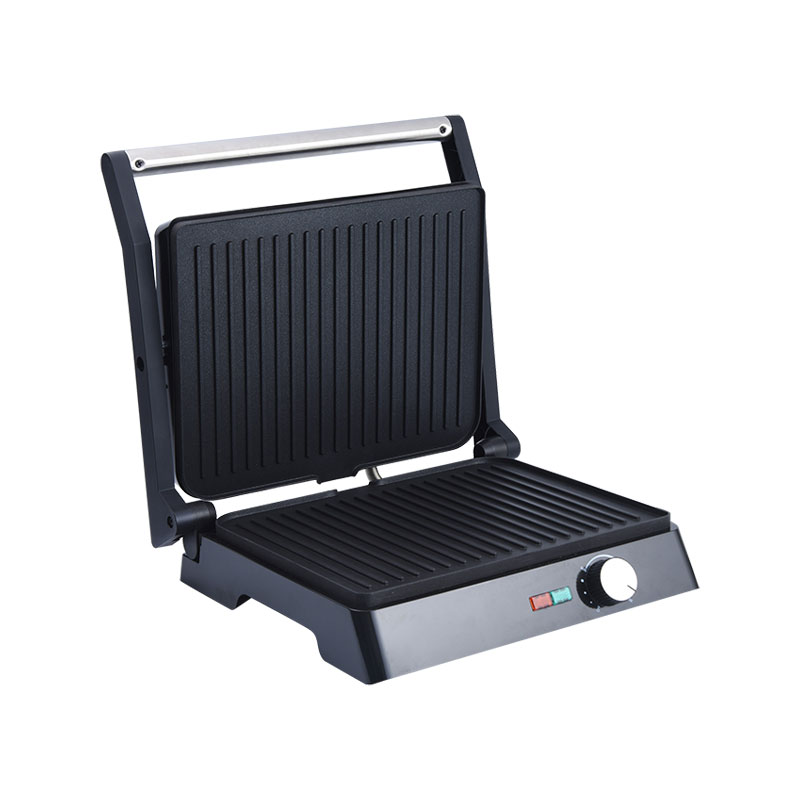 Double-sided Lift Grill1. Dual disk simultaneous heating, high thermal conductivity efficiency. 2. Independent temperature control system for upper and lower baking pans. 3. Lightweight desi...View Product →
A double-sided lift grill is a useful example of how surface design drives tool selection. Because food is pressed between two heated plates, the user needs a turner that can reach into a confined gap without levering against the upper plate, and tongs with enough length to rotate items without touching the hot body. The tool geometry has to follow the appliance geometry, not the other way around.
Material choice on the cookware side feeds back into tool durability expectations as well. Lightweight alloy cooking surfaces reduce the effort of handling, and the tools that accompany them can be sized for comfort rather than for brute force. Our manufacturing operation produces both the alloy components and the finished cooking appliances, which means tool geometry and surface geometry can be developed against each other instead of being sourced separately and hoped into compatibility.
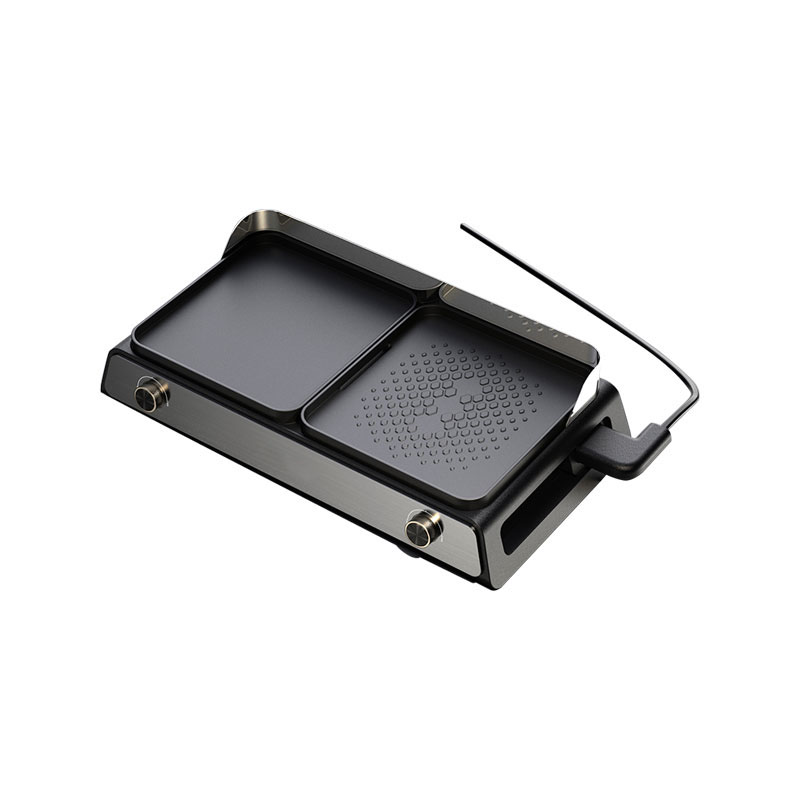 Magnesium Alloy Grill Pan1. The appearance is made of stainless steel material, with a simple design. 2. Dual zone, dual disk independent operating system. 3. Can cook different objects simult...View Product →
Where a magnesium alloy grill pan is used, the surface heats quickly and evenly, which shortens the window between raw and overcooked. That makes an instant-read thermometer more important, not less, and it makes a thin, flexible turner less useful because the margin for error is smaller. The tool set should be adjusted to the pan, and the specification sheet is where that adjustment happens.
Tools should be specified against the surface they will be used on. A set designed for an open grate and a set designed for a flat or enclosed cooking surface are two different products.
Outdoor cooking and indoor grilling generate different tool requirements, and mixing them produces sets that satisfy neither. Outdoors, the priorities are heat isolation, reach, and resistance to weather and grit. Indoors, the priorities shift toward ventilation-friendly cooking, easier cleaning, and tools that do not scratch a kitchen surface.
An outdoor set needs longer arms, higher heat ratings, and finishes that survive being left near a fire pit. An indoor grilling set can use shorter tools, handles that are dishwasher-safe, and a brush or scraper designed for a coated plate rather than a cast iron grate. The thermometer requirement is similar in both cases, but the indoor version benefits from a faster response time because the cooking window is shorter.
Indoor electric grill pans with removable plates change the cleaning sequence entirely. When the plate lifts out, the tool set no longer needs an aggressive wire brush; it needs a scraper that removes residue without marring the coating and a brush that reaches the oil channel. Sending an outdoor wire brush with an indoor appliance is a common and avoidable mismatch, and it is one of the reasons buyers see scratching complaints shortly after launch.
The underlying principle, and the reason smokeless indoor grilling has grown as a category, is that the appliance controls smoke at the source rather than relying on the user to manage it. If you want the technical background on how that works, there is a useful explanation in our article on what a smokeless grill is and how it works. For tool specification, the practical takeaway is that the appliance defines the workspace, and the tools have to fit that workspace precisely.
A supplier that builds both indoor and outdoor cooking appliances has an advantage here. The tool set can be matched to the actual cavity dimensions, plate thickness, and handle clearance of the appliance it ships with, rather than being selected from a catalogue and adjusted afterward.
Indoor and outdoor grilling tools are not interchangeable. Specify them against the appliance cavity, the plate coating, and the cleaning method the user will actually follow.
Most quality discussions focus on the factory. In practice, a large share of value loss happens after the product has been delivered, when the user's habits meet the tool's limits. Understanding which components fail first makes it possible to spend the quality budget where it changes the outcome.
The chart below ranks the components that most often generate complaints, based on the pattern of return and warranty feedback that is commonly reported across the outdoor cooking category. It is a practical ranking rather than a statistical study, and the exact order shifts with price tier and climate.
The ranking points to a clear pattern. The failures at the top of the chart are mechanical, not cosmetic. Tongs and turners are the two tools that carry the most load in normal use, so they are also the two tools where a small saving in material thickness produces a large increase in complaint rate. A supplier that upgrades only the visible parts of a set, such as the handle colour or the carry bag, will not move the ranking at all.
It is also worth noticing what sits in the middle. Handle failures are frequent enough to matter but less frequent than joint failures, which suggests that handle specification is better understood than pivot specification. Many buyers already ask about silicone ratings. Fewer ask how the handle is attached to the tang, even though that is where separation begins.
The thermometer position in the middle of the ranking is worth a comment. It is not the most complained-about item, but it is the one whose failure has the largest effect on perceived cooking quality. When a thermometer drifts by several degrees, the user does not blame the thermometer; the user concludes that the grill is inconsistent. That indirect cost is easy to underestimate.
The practical conclusion for a sourcing team is that quality investment should follow the ranking. Reinforcing the tong pivot, increasing turner blade thickness, and controlling handle attachment will remove more complaints than any change to packaging or appearance.
Complaints cluster on the two tools that carry the most load. Spending on the tong pivot and the turner blade returns more than spending on appearance.
For a distributor, wholesaler, or retail brand, the tool set question is ultimately a sourcing question. The same specification can be produced at very different landed costs depending on how the supplier is structured, and the cheapest quotation is rarely the cheapest outcome once returns and replacement shipments are included.
A trading company and a manufacturer will quote the same item differently, and the difference is not only margin. A manufacturer controls the stamping, welding, polishing, and assembly steps in one facility, which means a change in blade thickness can be implemented without renegotiating with a third party. It also means the person answering a technical question is usually the person who can change the process. That matters when a buyer wants to adjust a handle rating or reinforce a pivot in the middle of a development cycle.
Minimum order quantities in this category tend to be driven by the number of metal forming operations rather than by the final assembly. A set that uses a standard turner blank, a standard tong arm, and a standard brush head can be assembled in smaller batches than a set with a custom-drawn handle profile. Buyers planning a first order should expect to choose between a higher MOQ with custom tooling and a lower MOQ with catalogue components, and the decision should be made before the packaging artwork is finalised.
Lead time is the second variable. Tooling development, sampling, and approval typically consume several weeks before production begins, and ocean freight adds more. A supplier quoting roughly 45 days of average production lead time is describing the manufacturing window, not the door-to-door timeline. Buyers working to a seasonal deadline should build backward from the shelf date rather than forward from the purchase order.
Three questions separate a supplier that can support a brand from one that can only fill a container. First, can the supplier show test records for heat rating, coating adhesion, and bristle retention on the specific batch being shipped? Second, can the supplier adjust a specification mid-programme without changing the tooling? Third, does the supplier manufacture the metal components, or purchase them? The answers determine how quickly a quality issue can be corrected in the next production run.
Working with a manufacturer that also produces the cooking appliances the tools will accompany is a meaningful advantage for private-label programmes. Tool lengths, blade angles, and handle clearances can be validated against the actual appliance rather than against a drawing. It shortens the sampling cycle and removes a class of compatibility complaints that is otherwise very hard to diagnose after the fact.
Choose a supplier by asking who controls the process, not only what the unit price is. The ability to change a specification quickly is worth more than a small saving per piece.
A tool set that is well specified can still fail early if the user cleans it incorrectly. Stainless steel handles repeated washing well, but it does not tolerate prolonged contact with salt, acidic marinades, or chlorinated water. The most common cause of surface pitting in outdoor tools is not rain; it is a tool left in a closed container with a wet, salty brush.
The cleaning sequence that works best is simple. Scrape residue while the grate or plate is still warm, rinse the tools, wash with a mild detergent, and dry them fully before storage. Silicone and composite handles are generally dishwasher-safe, but wood handles are not, and packaging that does not distinguish between them will generate complaints from both directions.
Storage matters more than most buyers expect. A case that holds tools tightly against each other will abrade coated surfaces during transport. A case with a mesh panel or a drainage gap allows residual moisture to escape. A hanging loop on each tool removes the need for the case entirely for users who store tools on a hook, which is a common pattern in home outdoor kitchens.
For the thermometer, maintenance means calibration checks rather than cleaning. A simple ice-point check once a season is enough to catch drift before it affects cooking results, and including that instruction on the packaging costs nothing while reducing the most damaging category of complaint.
Most early corrosion and handle failures come from storage, not from cooking. Storage instructions are a quality feature, not a formality.
Six to ten pieces covers outdoor cooking well. Tongs, a turner, a two-pronged fork, a basting brush, an instant-read thermometer, and a grill brush or scraper form the core. A carry case and one or two supporting items bring the total into the range most buyers expect. Beyond ten pieces, additions tend to be novelty items that raise the price without improving cooking results.
304 is the better choice for tools that will be washed frequently and stored outdoors. It resists pitting more reliably, particularly in humid or coastal conditions. 430 stainless is acceptable for lighter-duty tools and lower price tiers, but the grade should be stated honestly for the whole tool, including the shaft, rather than only for the visible head.
A minimum of 200 °C is a practical target, and 230 °C gives more margin for users who work close to a hot firebox. The rating should be printed on the packaging or the handle itself. A handle rated correctly but not labelled will still generate melting complaints from users who assume every part of the tool is flame-proof.
Almost always because of the pivot construction. A single rivet through thin steel loosens as the metal expands and contracts across heating cycles. A welded or through-pinned pivot with a slightly thicker arm maintains tension much longer. This is the single highest-value upgrade in most outdoor tool sets.
Yes. Doneness is determined by internal temperature, not by time, and outdoor conditions vary far more than kitchen conditions. A thermometer with a response time under four seconds and an accuracy tolerance of about one degree is sufficient for home and semi-professional use.
Wire bristles can detach and end up on the cooking surface, which is a genuine safety concern. A coil or woven mesh brush with a firm scraper edge reduces that risk, and a stainless scraper used on a warm grate is the safest option. Whatever design is supplied, the packaging should instruct the user to inspect the brush before each use.
It can, but it will be a compromise. Indoor grilling benefits from shorter tools, dishwasher-safe handles, and a scraper suited to a coated plate. Outdoor cooking needs longer arms, higher heat ratings, and a brush that can handle a cast iron grate. If a single set must serve both, specify it against the harsher outdoor conditions and add a note about coated-surface care.
Batch test records for heat rating, coating adhesion, and bristle retention, plus a physical sample from the production run rather than from the pre-production sample. It is also worth confirming that the steel grade and thickness have not changed between runs, since silent substitutions are the most common cause of quality drift in this category.
The best grilling tools set for outdoor cooking is defined by its weakest specification, not by its longest feature list. Fix the tong pivot, the turner thickness, and the handle rating, and the rest of the set becomes far easier to sell.
Buyers who treat a grilling tool set as a packaging exercise usually end up managing returns instead of repeat orders. Buyers who treat it as a small engineering project, with defined steel grades, measured thicknesses, tested joints, and labelled heat ratings, end up with a product that survives a full outdoor cooking season and a customer who comes back for the next one.
The category does not reward complexity. It rewards consistency: the same blade thickness in every batch, the same pivot construction in every unit, and the same accuracy from every thermometer. That consistency is what separates a set that looks good in a photograph from one that still works in the second September of ownership.
Follow our social media to learn more about our updates


+86-13805815092

No. 11 Beihai Road, Xinqi Street, Beilun District, Ningbo City, Zhejiang Province, China
