


 中文简体
 English
 한국어
 日本語
 русский
 Español
 عربى
Industry News
Home / News / Industry News / Carne Asada Grilling: What Home Cooks and B2B Buyers Need From a Grill Pan
Oct 26, 2026
Content
Carne asada is decided in less than eight minutes. A skirt steak or a thin flank slice meets the heat, browns hard on both sides and comes off the fire before the muscle fibres tighten, usually somewhere between six and nine minutes from first contact to resting board. The lime, the cilantro, the salsa and the warm tortillas are there to support that sear, not to rescue it. When the surface under the meat is not hot enough, or when it drops thirty degrees the moment the steak lands, the result is grey meat sitting in its own juice, and no marinade can undo that.
So the useful question is not "which carne asada marinade is best" but "what is the cooking surface actually doing". Contact temperature, heat recovery, fat handling and smoke removal decide the outcome far more than the recipe does, and all four are engineering decisions that get locked in long before the grill reaches a kitchen. For a housewares brand, an importer or a wholesaler building a carne asada grill programme, those same four variables are the specification sheet.
This article covers what carne asada demands from a grill pan, how indoor electric grill pans handle thin cuts, where magnesium alloy cookware changes the weight equation, and what B2B buyers should put in writing before placing an order. Ningbo Victor Electrical Technology Co., Ltd., also operating as Victor Electric Appliance Technology Co., Ltd., manufactures indoor smokeless grill pans, a double-sided lift grill, magnesium alloy cookware and a broader kitchen appliance line, so the equipment side of carne asada can be discussed in concrete terms instead of generalities.
The conclusion first: carne asada is a contact-heat dish, so the cooking surface matters more than the marinade, and the three things worth checking are heat recovery, grease and smoke control, and the weight of the plate the cook has to lift.
Carne asada is a technique before it is a recipe. Meat is sliced thin, seasoned heavily and cooked fast over high, dry heat, then rested briefly and cut across the grain. That sequence puts four demands on whatever it is cooked on.
The classic cuts are skirt steak, flank, thin-cut sirloin, inside round and sometimes chuck, generally between one and two centimetres thick. Some regional styles go thinner still, closer to half a centimetre, because a very thin slice browns through in under two minutes per side. Thin meat has little thermal mass of its own, which means almost all of the browning energy has to come from the cooking surface. Surface temperature in the region of 230 to 260 degrees Celsius produces the crust that makes carne asada taste like carne asada; below roughly 180 degrees the meat releases water faster than it can brown, and it steams.
A thermostat reaching 240 degrees on an empty pan tells you very little. The real test is what happens in the first sixty seconds after a cold steak lands. A 1.5 centimetre slice straight from the refrigerator can pull 30 to 40 degrees out of a light plate almost instantly. A heavy plate with genuine thermal mass gives that heat back quickly, so the second side sears the same way the first one did. A thin plate does not, and that is where the grey band under the crust comes from.
Carne asada marinades are usually built on citrus juice, garlic, chili and salt, sometimes with a little oil or beer. Citrus and sugar burn. Rendered fat drips. Both produce smoke on contact with a hot surface, and that smoke is the single biggest reason people avoid cooking carne asada indoors. A grill pan that manages drips and airflow is not a luxury feature, it is what makes the dish usable in an apartment kitchen, a food truck with limited ventilation, or a tabletop setting at a retail demo.
A ribbed surface gives visible grill marks but touches the meat on perhaps half of its surface. A flat surface touches almost all of it, which is why most indoor electric grill pans and griddles go flat or lightly grooved. For carne asada, where the slice is thin and the cook wants an even crust rather than decoration, more contact generally wins.
Thin carne asada slices depend on the pan for nearly all of their browning energy, so heat recovery under load is the specification that separates a working grill pan from a decorative one.
There is no single best carne asada grill, because there is no single place where carne asada gets cooked. A family cooking two steaks on a Tuesday night, a small taqueria running forty covers an hour and a retailer demonstrating product on a shop floor have three different problems. The equipment that solves each one looks different.
For household and small commercial use, an electric grill pan with a thermostat and a removable plate covers most of the carne asada workflow. A thermostat lets the cook hold the surface near the searing band instead of guessing, and a removable plate means the marinade residue and rendered fat can be washed properly rather than wiped off. The large-size indoor electric smokeless grill pan with a removable grill is built around exactly that pattern: a wide flat contact area for flank and skirt slices, a plate that lifts out for cleaning, and a body designed to keep the cooking zone contained instead of letting fat run across the countertop.
A smaller version of the same idea, the small-size indoor electric smokeless BBQ grill pan with temperature control, suits one or two people, dorm kitchens and countertops where a large footprint simply will not fit. Both models target the same cooking problem at different scales, which matters for a wholesaler assembling a range: one tooling programme, one spare-parts list, two price points.
Where volume matters more than countertop space, a double-sided design makes more sense than a single plate. The double-sided lift grill cooks from above and below at the same time, so a batch of thin carne asada slices does not need to be flipped by hand and does not need the cook to stand over it. For carne asada specifically, that reduces the most common failure point in home cooking, which is leaving the first side on too long while preparing the tortillas, then rushing the second side. A lift-style grill also keeps marinade spatter inside the unit rather than on the backsplash, which is a practical benefit in rented apartments and open-plan kitchens.
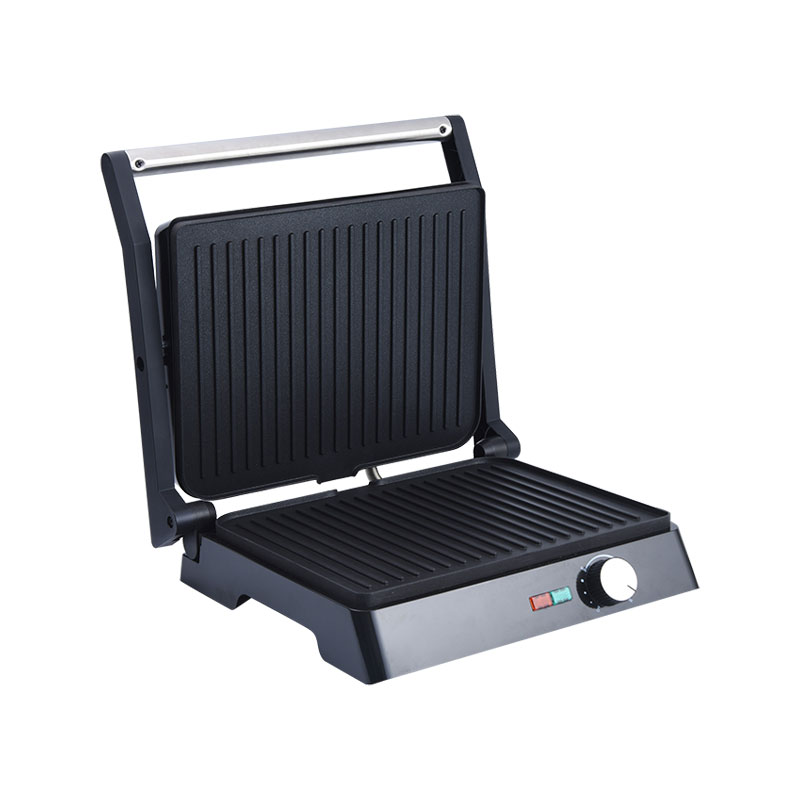 Double-sided Lift Grill1. Dual disk simultaneous heating, high thermal conductivity efficiency. 2. Independent temperature control system for upper and lower baking pans. 3. Lightweight desi...View Product →
Choosing between the two formats usually comes down to two questions. How many servings must be seared back to back, and how much counter space and storage space does the buyer actually have? Answer those first, and the format decision becomes straightforward.
Pick a flat thermostat-controlled grill pan for thin carne asada slices cooked to order, and a double-sided lift grill when several portions have to be seared at the same time.
The two factors that separate a grill pan that sears from one that steams are how hot the surface stays under load and how quickly it recovers after a cold slice of meat lands on it. The chart below compares how different contact surfaces typically behave once a chilled steak is placed on them, which is the moment most grill specifications stop being theoretical.
The chart is deliberately simple, because the buying decisions behind it are simple too. Heavier plates recover faster but take longer to preheat and cost more to ship. Lighter plates reach temperature quickly and are easier to handle, but they sag under a cold steak unless the plate thickness and heater contact are specified together. Magnesium alloy sits in an interesting middle position: it conducts heat quickly, closer to aluminium than to cast iron, while holding more heat per kilogram than aluminium does, so recovery is good without the shipping and handling penalty of a heavy iron plate.
Smoke control is the second half of the same problem, and it is not solved by the plate alone. The airflow path, the distance between the heating element and the plate, the drip tray volume and the way fat is channelled away from the hottest zone all influence how much smoke reaches the room. A grill pan that is described as suitable for indoor carne asada should be able to hold a 230 degree surface while the marinade burns off and still keep visible smoke low for the length of a normal cooking session, which in practice is twenty to thirty minutes of continuous use.
For a brand assembling a product line, these two variables also set the marketing language. A grill pan with genuine heat recovery and a contained drip system can be positioned for indoor carne asada, indoor Korean barbecue, teppanyaki-style cooking and breakfast griddling from the same tooling. A light plate without those features has to be sold as an entry-level contact grill, and a buyer who tries carne asada on it once may not come back.
Test heat recovery with a chilled steak rather than a preheat reading, because that is the moment when carne asada either sears or steams.
Weight is the least glamorous specification in cookware and one of the most commercially important. A grill pan that a customer cannot lift comfortably with one hand tends to stay in the cupboard. For the same plate volume, magnesium alloy is roughly a third lighter than aluminium and around three quarters lighter than cast iron, which changes what a 32 centimetre grill pan feels like at the handle and what a container of them costs to ship.
Thermally, magnesium alloy transfers heat quickly, so preheating is fast, and it holds more heat per kilogram than aluminium, which helps with recovery when cold meat is placed on the surface. That combination suits carne asada, where the cook needs a fast start and a stable surface for the four to six minutes the slices spend on the heat, but does not want to wrestle a heavy pan out of a cupboard on a weeknight.
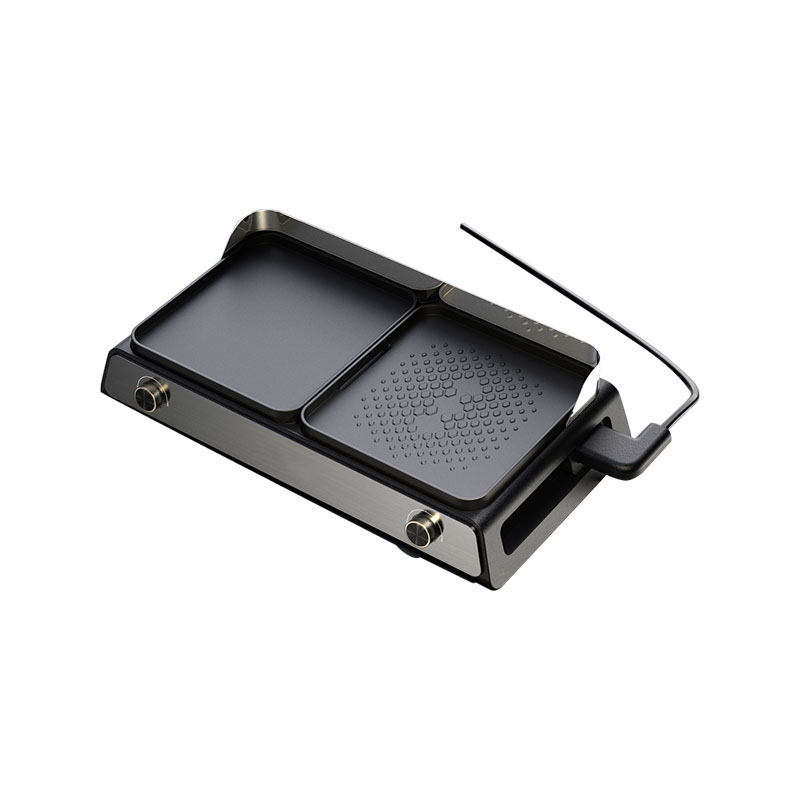 Magnesium Alloy Grill Pan1. The appearance is made of stainless steel material, with a simple design. 2. Dual zone, dual disk independent operating system. 3. Can cook different objects simult...View Product →
Material choice also has a supply chain dimension. Victor Electric Appliance Technology manufactures magnesium alloy cookware alongside a separate magnesium and aluminium mould and parts processing business, including aluminium alloy component processing, mould processing and semi-solid magnesium alloy component processing. For a buyer, that means the material side of a grill pan programme can be discussed with the same supplier that makes the finished appliance, rather than being split across a cookware vendor and an appliance vendor with two sets of tolerances, two sample loops and two lead times.
It is worth being clear about what material choice does not do. It does not fix a weak heater, a thermostat with a wide tolerance band, or a drip tray that overflows during a heavy carne asada session. Material is one variable in a system, and it should be specified alongside power, plate thickness and grease management rather than instead of them.
Magnesium alloy reduces weight and preheat time without giving up heat recovery, which makes it a practical choice for a carne asada grill pan that has to be lifted and stored daily.
Most sourcing problems on a grill programme are not manufacturing problems, they are specification problems. The brief says "indoor grill pan for carne asada" and both sides fill in the gaps with their own assumptions, which then show up as a sample that cooks well but is too heavy, or one that is light enough but smokes. The table below lists the areas worth writing down before tooling starts.
| Specification area | What to lock down | Why it matters for carne asada |
|---|---|---|
| Contact material and plate thickness | Magnesium alloy, die-cast aluminium or coated steel, with a stated plate thickness, typically 3 to 4 mm | Decides heat recovery under a cold steak; thin plates drop temperature and grey the meat |
| Power and thermostat range | Wattage, usable surface temperature band and thermostat tolerance, not just peak temperature | Searing needs sustained heat at roughly 230 to 260 degrees Celsius, not a brief spike |
| Grease and drip management | Drip tray volume, channel design, removable and dishwasher-safe parts | Citrus marinade and rendered fat run heavily; overflow becomes a customer complaint |
| Smoke control | Airflow path, water tray or filter, distance between element and plate | Determines whether the product can honestly be sold as suitable for indoor cooking |
| Cleaning and spare parts | Tool-free plate release, coating durability, availability of replacement plates | Repeat use depends on how long cleanup takes after a sticky marinade session |
| Documentation and compliance | Test reports, voltage and plug variants, packaging drop-test results | Importers need paperwork before the container is booked, not after it arrives |
| Commercial terms | Minimum order quantity, tooling ownership, sample and production lead times, private-label artwork | These terms, not the product photo, set the actual launch date |
Two further points are worth adding to any brief. First, ask for cooking trials with an actual carne asada marinade rather than plain water or oil, because sugar and acid behave differently on a hot coated surface and can reveal coating or cleaning problems that a plain sear test will miss. Second, ask for the drip tray to be tested at capacity, not at a light load, since customers rarely stop at one portion.
Buyers sourcing from a manufacturer rather than a trading company also gain access to the tooling conversation. Plate thickness, rib pattern, coating and handle geometry all come from the mould, and adjusting them after tooling is expensive. When the same supplier makes both the magnesium and aluminium parts and the finished appliance, changes to the cooking surface can be evaluated before mass production instead of after.
A carne asada grill brief should specify heat recovery, drip capacity and smoke behaviour in writing, because those three points cause most post-launch returns.
Ningbo Victor Electrical Technology was established in 2019 and works as an ODM and OEM kitchen appliance manufacturer, with product development concentrated in coffee machines, waffle makers, indoor smokeless grill pans, grills, steamers and sandwich makers. The development history is fairly specific: two waffle maker models in 2021, two indoor smokeless grill pan models in 2022, two steamer models in 2023, and two coffee machine models in 2025. For a buyer, that pattern is useful information, because it suggests a supplier that adds categories in planned steps rather than scattering models across a catalogue.
Two published operating figures help with planning. The company reports an annual export rate of about 60 percent and an average delivery time of roughly 45 days. In practice, a private-label grill pan project usually follows a sequence: brief and specification review, sample or prototype, cooking and cleaning evaluation, artwork and packaging, then mass production and inspection. Samples and tooling sit on the critical path, so a realistic project plan should treat the 45 day figure as production time and add the sample and approval stages on top of it.
Because the site is published in several languages and includes dedicated sections for manufacturing, factory honours, ODM/OEM cooperation and testing guidance, much of the documentation an importer would normally request during due diligence is already available. For a wholesaler or brand owner, the practical approach is to arrive with a specification table like the one above, ask for a sample that matches it, and test that sample with real carne asada marinade before committing to volume.
Plan a carne asada grill launch around sample and approval stages first, and treat the roughly 45 day production window as the second half of the timeline.
Skirt steak and flank are the traditional choices, generally sliced one to two centimetres thick, with thin-cut sirloin and inside round as common alternatives. Very thin slices, around half a centimetre, brown through quickly and suit fast cooking on a flat grill pan, while thicker cuts need a little more time per side and a surface that holds its temperature.
Yes, but it depends on the equipment rather than on the cook. An indoor electric grill pan with a contained drip tray, controlled airflow and a thermostat that holds a steady surface temperature produces noticeably less smoke than an open pan on a hob. Marinade residue and rendered fat are the main smoke sources, so a design that keeps both away from the hottest zone makes the biggest difference.
Somewhere between 230 and 260 degrees Celsius is a useful working range for a fast sear on thin slices. Just as important is how quickly the surface returns to that range after a chilled steak is placed on it, which is why plate thickness and material matter as much as wattage on the specification sheet.
Flat surfaces give more contact and therefore a more even crust, which suits thin carne asada slices. Ribbed surfaces produce visible grill marks and allow fat to run off, which some cooks prefer for thicker cuts. Many indoor electric grill pans use a lightly grooved or flat plate as a compromise.
Thirty minutes is enough for thin slices, and two to four hours is a common upper limit for a citrus-based marinade. Leaving thin meat in an acidic marinade much longer than that starts to break down the surface texture, and a soft, mushy exterior will not sear well no matter how hot the grill pan is.
Magnesium alloy is lighter than aluminium and much lighter than cast iron for the same plate volume, while transferring heat quickly and holding a reasonable amount of heat per kilogram. In daily use that means a pan that is easy to lift, preheats quickly and still recovers temperature between batches.
Most electric grill pans with coated plates need the plate to cool before cleaning and should not be scrubbed with abrasive pads. Removable plates make this easier, and buyers sourcing at volume should confirm that spare plates and coating specifications are available, since cleaning habits vary a great deal between markets.
Look for a manufacturer that can discuss both the cooking surface and the electrical assembly, provides test documentation with the sample, and gives clear terms on minimum order quantity, tooling ownership and lead time. An ODM or OEM partner that also produces its own magnesium and aluminium parts can usually adjust plate thickness or rib patterns without involving a third party, which shortens the sample loop considerably.
Carne asada questions almost always come back to the same three answers: a hot recovered surface, contained fat and smoke, and a plate light enough to use every week.
If you want to go deeper into how the equipment behind a carne asada grill programme is actually built, the two pages below cover the manufacturing side and the smoke control principle in more detail.
Carne asada is a good test case for any grill pan, because it exposes everything at once: thin meat that needs immediate heat, a sticky marinade that produces smoke, and rendered fat that has to go somewhere. A product that handles carne asada well will usually handle burgers, vegetables and breakfast griddling without much trouble. That is why the specification work described here tends to pay off across an entire product line rather than for a single dish.
For brands, importers and wholesalers evaluating indoor grill pans, magnesium alloy cookware or a wider kitchen appliance range, the sensible next step is to bring a written specification list, request a sample cooked with real carne asada marinade, and compare the results against the heat recovery and smoke behaviour that customers will actually experience at home.
Test any candidate grill pan with real carne asada before committing to volume, because one cooking session reveals more than a full page of specifications.
Follow our social media to learn more about our updates


+86-13805815092

No. 11 Beihai Road, Xinqi Street, Beilun District, Ningbo City, Zhejiang Province, China
