The direct answer for households comparing countertop cooking equipment is this: a double-sided lift Home Grill with independent upper and lower temperature control offers a faster, more even cooking result than a single plate design, because both sides of the food are heated at the same time rather than requiring a mid cook flip. This design is particularly useful for a Home Barbecue Grill used for weekday cooking, since it shortens total cooking time while keeping the appliance compact enough for a standard kitchen counter. The remainder of this article explains the engineering behind dual disk heating, independent temperature zones, safety sensing, and non-stick coating, and it outlines practical guidance for choosing and maintaining a double-sided lift grill for daily home use.
A double-sided lift grill is a countertop cooking appliance built around two heated plates, an upper plate and a lower plate, that close together around the food being cooked. Unlike a traditional single surface pan or griddle, this design applies heat from both sides simultaneously, which is the main reason it is frequently chosen as a practical Home Grill for meats, vegetables, sandwiches, and other foods that benefit from even browning on both surfaces. The lift hinge mechanism allows the upper plate to accommodate different food thicknesses, so the appliance can adapt from thin slices to thicker cuts without leaving a gap that reduces contact heat transfer.
This structural approach is well documented in general small kitchen appliance engineering literature, where contact grilling is described as a heat transfer method that relies on direct surface contact rather than convection or radiant heat alone. Because both plates make direct contact with the food, a double-sided lift grill can reduce total cooking time compared to a single plate device that requires manual flipping partway through the cooking process.
The lift hinge design itself borrows from a long standing category of contact cooking appliances that has been used in commercial kitchens for many years before becoming common in home settings. In a commercial environment, two sided contact heating is valued because it standardizes cooking time across a large volume of orders, since the operator does not need to judge when to flip each item individually. A household version of this same mechanical principle, scaled down into a lightweight, countertop friendly Home Grill, brings a similar consistency benefit to everyday home cooking without requiring commercial scale equipment or a dedicated cooking station.
Why Dual Disk Heating Improves Everyday Cooking Results
Dual disk simultaneous heating means that both the upper and lower cooking plates are powered by their own heating element rather than sharing a single heat source. This structure allows more consistent surface temperature across both plates during use, which in turn supports more even browning and reduces the likelihood of one side of the food finishing before the other. For a household using the appliance as a regular Home Barbecue Grill, this consistency is one of the most noticeable everyday benefits compared to older single plate designs.
Independent Temperature Control for Upper and Lower Plates
An independent temperature control system for the upper and lower baking pans allows each plate to be set to a different heat level, which is useful because many foods do not require identical heat on both sides. A thick cut of meat, for example, may benefit from a slightly higher lower plate temperature to build a sear, while the upper plate can be set lower to avoid over browning the top surface before the interior is fully cooked. This flexibility is one of the clearer functional advantages of a well engineered double-sided lift grill compared to a fixed single temperature contact grill.
This radar chart presents an illustrative, relative comparison between a double-sided lift home grill and a conventional single plate contact grill across five commonly discussed performance dimensions, rather than a laboratory certified benchmark. Cooking speed and even heating both favor the double-sided design, which lines up with the basic principle that simultaneous two sided heat transfer reduces total cook time compared to a single sided surface. Versatility also tends to score higher for the double-sided lift design because independent upper and lower temperature control allows the appliance to adapt to a wider range of food thickness and type. Ease of cleaning is fairly close between the two categories, since both designs commonly use a non-stick coating, though a single plate grill can sometimes be marginally simpler to wipe down due to its flatter, more open surface. Portability shows the single plate grill with a slight edge in this illustration, reflecting the fact that a simpler single heating element design is often lighter, though a well engineered double-sided lift grill with a lightweight body and anti-slip handle can narrow this gap considerably. Readers should treat this chart as a directional guide to feature trade-offs rather than a definitive ranking, since actual performance depends on the specific model and how it is used.
Safety Engineering: Intelligent Fire Sensing and Overload Protection
Safety features have become a significant differentiator in the home kitchen appliance category as more households use countertop cooking equipment on a daily basis. Intelligent fire sensing technology is designed to monitor the heating circuit during operation and respond to abnormal conditions, while automatic overload power-off protection is designed to cut power if the appliance detects a current level outside its normal operating range. Together, these systems are intended to reduce the risk of overheating during unattended or extended cooking sessions, which is particularly relevant for a Home Grill used frequently by families with varying levels of cooking experience.
How These Protections Fit Into Daily Use
In practical terms, these protections work in the background and do not require the user to take any extra steps during normal cooking. The value becomes clearer in less common situations, such as a brief distraction while cooking or a plate left in the closed position slightly longer than intended, where automatic protection reduces the chance of a fault condition escalating. Combined with a lightweight body and an anti-slip silicone handle that stays cool to the touch during operation, these features are part of a broader design philosophy that treats everyday safety as a core specification rather than an optional add-on.
Non-Stick Coating and Everyday Cleaning
Food-grade non-stick coating is one of the most practical features for a household appliance used several times a week. A well applied non-stick surface reduces the amount of oil needed during cooking, helps food release cleanly from the plate without tearing, and shortens the time required for post cooking cleanup, which is one of the most commonly cited reasons households give for choosing an electric contact grill over a traditional stovetop pan for quick meals.
Illustrative comparison of common home cooking surfaces and typical maintenance considerations
Cooking Surface Type
Typical Oil Requirement
Typical Cleaning Effort
Common Use Case
Traditional Stovetop Pan
Higher
Moderate to High
General stovetop cooking
Single Plate Contact Grill
Low to Moderate
Low to Moderate
Quick single side cooking
Double-Sided Lift Home Grill
Low
Low
Two sided grilling, sandwiches, meats, vegetables
Growing Household Interest in Indoor Home Grilling
Home cooking trend commentary over the past several years has repeatedly noted growing household interest in compact indoor cooking appliances that reduce reliance on outdoor equipment and shorten weekday meal preparation time. A Home Barbecue Grill designed for indoor countertop use fits this pattern well, since it allows grilling style cooking year round regardless of outdoor space, weather, or building restrictions on open flame cooking.
This area chart presents a relative, illustrative index of indoor home grill search and adoption interest across four recent annual periods, intended to visualize a directional pattern discussed broadly in home appliance trade commentary rather than a specific published statistic. The upward trend reflects general commentary suggesting that compact countertop grilling appliances have gained steady household interest as more consumers look for quick, low mess ways to prepare grilled style meals without an outdoor setup. Apartment living and space constrained kitchens are frequently cited as contributing factors, since a double-sided lift grill occupies a small counter footprint compared to a full outdoor barbecue unit. Interest in healthier home cooking methods, including reduced oil usage supported by non-stick coating, is another factor commonly referenced alongside this trend in general consumer appliance commentary. The steepening curve toward the later periods in this illustration mirrors the broader observation that countertop grilling appliances have moved from a niche category toward a more mainstream kitchen appliance segment in many markets. Readers should treat this chart as a directional planning reference rather than a market forecast guarantee.
Common Cooking Applications for a Double-Sided Lift Grill
A double-sided lift grill is commonly used across a fairly wide range of everyday foods, which is part of why it is often positioned as a general purpose Home Grill rather than a single purpose appliance. Understanding typical usage patterns can help a household decide whether the appliance fits their regular cooking routine.
This donut chart presents an illustrative usage composition seen across general household reporting on countertop grill appliances, based on commonly cited category proportions rather than a specific audited data set. Meats and sandwiches together make up the largest share of typical use, which fits the core value proposition of a double-sided lift grill: even two sided heating that shortens cooking time for foods that traditionally require a mid cook flip. Vegetables represent a meaningful secondary use case, particularly for households seeking a lower oil cooking method supported by the non-stick coating. Seafood is a smaller but consistent category, often selected because the independent upper and lower temperature control allows a gentler heat setting appropriate for delicate proteins. Breakfast items such as toasted sandwiches or warmed items make up the smallest share in this illustration but are frequently mentioned in general appliance usage commentary as a common weekday application. Households considering a double-sided lift grill can use this composition as a general reference point when deciding whether the appliance matches their typical weekly cooking pattern.
Beyond the broad category split shown above, usage patterns also tend to shift with household size and season. A single person or couple often uses a compact double-sided lift grill mainly for quick weekday meals such as sandwiches or a single portion of meat or vegetables, while a larger household preparing meals for several people at once tends to rely more heavily on the appliance for sequential batches of meat or seafood, where consistent, repeatable heating from one round of cooking to the next becomes more important. Weekend cooking patterns commonly skew toward larger cuts of meat or mixed vegetable and protein plates, since there is typically more time available for a slightly longer cooking session, while weekday use tends to favor faster, simpler foods such as sandwiches or thinner cuts. Recognizing these patterns can help a household select a plate size and heating capacity that matches their actual cooking habits rather than defaulting to the largest available option.
Heat Distribution Across Common Foods and Settings
Because the upper and lower plates can be adjusted independently, it is useful to visualize how different heat settings tend to pair with different food categories in everyday use. The heatmap below presents an illustrative view of relative heat intensity commonly associated with several food types across a low, medium, and high setting range, intended as a general reference rather than a precise cooking instruction for any specific model.
This heatmap presents an illustrative pattern of relative heat intensity commonly associated with different food types and settings on a double-sided lift grill, rather than a fixed temperature chart for any particular model. Meats generally sit toward the higher heat end of the scale, since thicker cuts benefit from a stronger sear and a higher internal temperature to reach safe doneness within a reasonable cooking time. Sandwiches also tend toward a medium to high setting, since a firmer, more defined grill mark and a fully melted filling typically require a reasonably strong heat level. Vegetables generally sit in the low to medium range, since excessive heat can char the exterior before the interior softens properly, and a gentler setting preserves texture and natural moisture. Seafood follows a similar low to medium pattern in this illustration, reflecting general cooking guidance that delicate proteins benefit from a controlled, moderate heat level rather than the highest available setting. Because the double-sided lift grill supports independent upper and lower temperature control, households can approximate these relative patterns by adjusting each plate separately rather than relying on a single fixed heat setting for every food type.
Indoor Home Grill Compared to Outdoor Barbecue Equipment
One of the most common questions households ask when considering a Home Barbecue Grill is how an indoor countertop appliance compares to traditional outdoor barbecue equipment in terms of practical, everyday usability. The main structural difference is that outdoor barbecue equipment is generally used seasonally and depends on weather, outdoor space, and in some buildings, restrictions on open flame cooking, while an indoor double-sided lift grill can be used consistently throughout the year regardless of these constraints.
This stacked bar chart presents an illustrative comparison of seasonal usage distribution between an indoor double-sided lift grill and typical outdoor barbecue equipment, based on general seasonal cooking commentary rather than a specific survey data set. The indoor home grill bar shows a relatively even distribution across all four seasons, reflecting its main practical advantage: consistent availability regardless of outdoor temperature, precipitation, or daylight hours. The outdoor barbecue bar, by contrast, shows usage concentrated heavily in the warmer months, with very limited activity during colder periods in most climates, which is a well documented seasonal pattern in general outdoor cooking commentary. This difference matters for households that want grilling style meals as a regular part of their routine rather than an occasional warm weather activity, since an indoor appliance removes the seasonal gap entirely. It is worth noting that outdoor barbecue equipment often supports larger batch cooking and different flavor profiles associated with open flame or charcoal methods, so the two categories generally serve complementary rather than fully interchangeable roles in a household's cooking routine. Many households end up using both, with the indoor double-sided lift grill covering weekday and off season needs while outdoor equipment remains reserved for warm weather gatherings.
Common Design Variations in Home Grill Products
Countertop grilling appliances are available in several plate configurations, and understanding these variations helps clarify why a double-sided lift design is positioned differently from other formats within the same general category. Flat single plate grills use one open heated surface and require the user to flip food manually partway through cooking. Panini style plates typically include raised ridges designed to press grill marks into bread and compress sandwich fillings, and this style is often combined with a lift hinge similar to the double-sided design discussed throughout this article. Fully flat contact grills close around food from both sides but generally lack independent temperature control, applying a single heat setting to both plates rather than allowing separate adjustment. A double-sided lift grill with independent upper and lower temperature control effectively combines the two sided contact heating of a panini style appliance with the added flexibility of separately tunable heat zones, which is part of why it is frequently positioned as a more versatile general purpose Home Grill option.
Plate Material and Coating Differences
Plate material also varies across the category. Aluminum plates with a food-grade non-stick coating are common because aluminum conducts heat efficiently and keeps the overall appliance weight low, which supports easy lifting and storage. Stainless steel is frequently used for the exterior housing and hinge components, since it holds up well to repeated handling and resists surface staining better than painted metal over the appliance's service life. The combination of a lightweight aluminum non-stick cooking plate with a more durable stainless steel exterior structure is a common approach in the category, balancing cooking performance with everyday handling durability.
Fitting a Home Grill Into a Weekly Meal Routine
A double-sided lift grill tends to work best when it is matched to a household's actual weekly cooking rhythm rather than treated as an occasional special use appliance. The following list outlines common ways households incorporate a home grill into a regular meal routine.
Weekday breakfast: toasted sandwiches or warmed items prepared quickly before work or school using a lower, consistent heat setting.
Weeknight dinners: a single portion of meat, seafood, or vegetables cooked in one short session with minimal added oil.
Weekend batch cooking: sequential cooking of larger quantities of meat or vegetables for meal preparation across the coming week, relying on quick thermal recovery between batches.
Casual gatherings: a compact alternative to outdoor barbecue equipment when hosting a small indoor gathering during colder months or in a space without outdoor access.
Simple cleanup routines: wiping down the non-stick plate immediately after use while it is still warm but not hot, which is generally easier than cleaning a fully cooled surface.
Heating Efficiency and Thermal Response
Thermal conductivity efficiency is a core engineering consideration for any contact grill, since the speed at which a plate reaches and maintains its target temperature directly affects total cooking time and consistency. A high thermal conductivity design allows dual disk heating elements to recover temperature quickly after food is placed on the plate, which helps maintain consistent searing and browning throughout the cooking process rather than only at the start.
This gauge chart illustrates a relative thermal response impression for a dual disk double-sided lift grill, positioned toward the higher end of the scale to reflect the general engineering principle that simultaneous two sided heating with high thermal conductivity plates recovers temperature faster than a single plate design after food is added. The needle position is illustrative and intended to visualize a general tendency described in small appliance engineering commentary rather than a certified test result for any single unit. Faster thermal response matters directly to everyday cooking consistency, since a plate that recovers temperature quickly reduces the risk of undercooked centers or uneven browning when multiple portions are cooked in sequence. Independent upper and lower temperature control adds a further layer of precision on top of this thermal response, allowing each plate to be tuned separately once the base thermal performance is established. Households cooking for multiple people in one sitting are likely to notice this attribute more than occasional single portion users, since sequential cooking sessions rely heavily on how quickly the plates recover heat between uses. Reading this gauge alongside the earlier radar chart provides a more complete picture of how heating performance and overall usability compare across grill designs.
Product Overview: Double-Sided Lift Grill
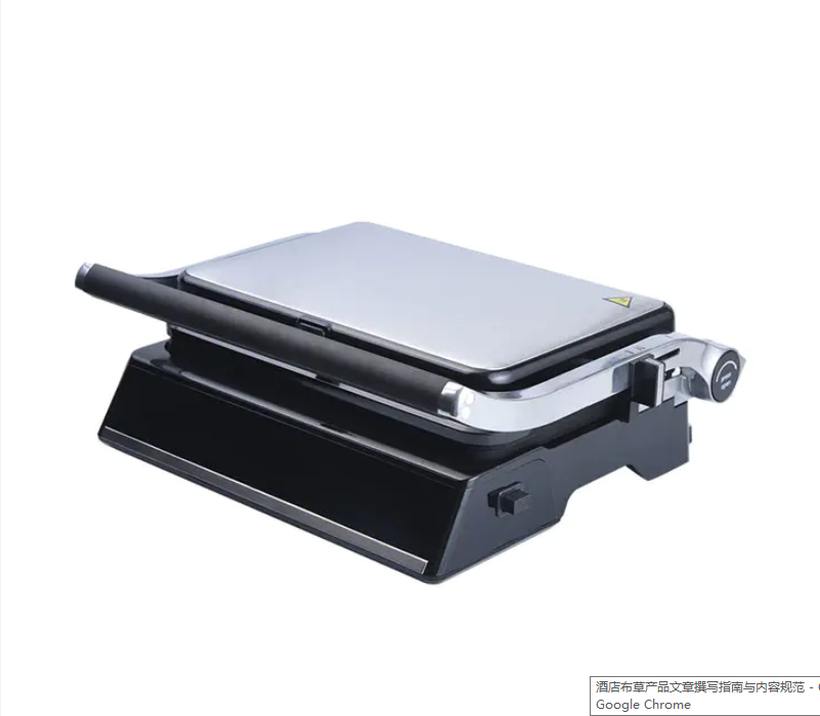
The image below shows a representative double-sided lift Home Grill featuring a stainless steel upper plate, a lift hinge mechanism, an anti-slip silicone handle, and a compact base designed for everyday countertop use.
This design reflects the core features discussed throughout this article: a lightweight overall structure, a stainless steel top surface paired with a food-grade non-stick cooking plate, a lift hinge that adjusts to different food thicknesses, and a compact base housing the dual disk heating elements and independent control system.
Isometric Structural Diagram
The isometric schematic below illustrates the main structural components of a double-sided lift grill in a simplified three dimensional view, showing how the upper plate, lift hinge, handle, and base housing relate to one another.
This isometric schematic groups the double-sided lift grill into four functional zones that correspond directly to the features discussed earlier in this article. The upper plate, shown at the top of the assembly, houses one of the two independently controlled heating elements and is connected to the lift hinge that allows it to rise and adapt to different food thicknesses. The lift hinge itself is the mechanical component that distinguishes this category from a fixed single plate grill, since it allows the upper plate to make consistent contact with food of varying height rather than remaining in a single fixed position. The base housing contains the lower heating disk, the independent temperature control electronics, and the intelligent fire sensing and overload protection circuitry discussed in the safety section above. The anti-slip feet and silicone handle, shown at the base and side of the diagram, support safe handling and stable countertop positioning during use, which matters given that the appliance is lifted and repositioned regularly during everyday cooking. Reviewing this structural breakdown alongside the earlier radar and gauge charts gives a fuller picture of how the mechanical design of a double-sided lift grill supports its functional performance.
Understanding Heating Capacity and Plate Size
Heating capacity and plate surface area are two practical specifications worth understanding before selecting a double-sided lift grill, since they directly affect how much food can be cooked in a single session and how quickly the plates recover heat between batches. A larger plate surface allows more food to be cooked at once, which benefits larger households or anyone preparing meals for several people in a single sitting, while a smaller plate footprint is generally easier to store and better suited to a compact kitchen. Heating capacity, meanwhile, relates to how quickly the dual disk elements can bring the plates up to the selected temperature and recover that temperature once food is added, which ties directly back to the thermal response behavior discussed earlier in this article.
Matching Capacity to Household Needs
A single person or couple cooking mainly individual portions will generally find a moderate plate size and heating capacity sufficient for daily use, since batch size requirements are naturally smaller. A larger household, or anyone who frequently entertains guests indoors, may place more value on a plate size and heating capacity that supports sequential batches without a significant drop in performance between rounds. Rather than assuming that a larger specification is automatically the right choice, it is generally more useful to match plate size and heating capacity to actual, observed household cooking patterns, which keeps the appliance practical for daily storage and handling while still meeting real cooking needs.
Maintenance and Cleaning Guidelines
Proper maintenance extends the usable life of a double-sided lift grill and preserves the performance of its non-stick coating over repeated use. The following practices are commonly recommended in general small kitchen appliance care guidance.
Allow the plates to cool fully before cleaning to avoid warping the non-stick surface or causing burns during handling.
Use a soft cloth or sponge rather than abrasive scouring pads, since abrasive tools can gradually wear down the non-stick coating.
Wipe the stainless steel exterior with a soft, slightly damp cloth to maintain its appearance without leaving streaks.
Check the anti-slip silicone handle periodically for wear, since a secure handle grip supports safe lifting of the upper plate.
Store the appliance in a dry location to protect the heating elements and electronic control components from moisture exposure.
Choosing a Home Grill: A Practical Checklist
The following checklist summarizes practical questions worth considering before choosing a double-sided lift Home Grill or Home Barbecue Grill for regular household use.
Does the appliance offer independent upper and lower temperature control for different food types.
Is the cooking surface finished with a food-grade non-stick coating for easier daily cleanup.
Does the unit include intelligent fire sensing and automatic overload power-off protection.
Is the overall body lightweight enough for convenient everyday storage and handling.
Does the handle include an anti-slip silicone grip for safe lifting during and after cooking.
Is the lift hinge mechanism able to adjust to different food thicknesses without leaving excessive gaps.
Company Introduction
Ningbo Victor Electrical Technology Co., Ltd., operating as Victor Electric Appliance Technology Co., Ltd., specializes in the research, development, and manufacturing of kitchen appliances, with a focus on delivering convenient, efficient, and intelligent solutions for modern households worldwide. Since its establishment in 2019, Victor has focused on product innovation and continuous expansion across key segments such as coffee machines, waffle makers, smokeless grill pans, and steam cookers. With a growing portfolio of self-developed models, including double-sided lift Home Grill products, the company has built a strong product lineup and an expanding presence in international markets. Guided by the values of integrity, responsibility, and win-win collaboration, Victor continues to strengthen its manufacturing foundation, quality control system, and automation capabilities. This ongoing investment in research and development supports a product design process that treats everyday safety features, such as intelligent fire sensing and automatic overload protection, alongside cooking performance as equally important parts of the engineering process, rather than treating safety as a separate afterthought added late in development.
Frequently Asked Questions About Home Grills
Q1: What makes a double-sided lift grill different from a single plate grill.
A: A double-sided lift grill heats food from both the top and bottom at the same time using dual disk heating elements, which generally reduces total cooking time compared to a single plate design that requires manually flipping the food partway through cooking.
Q2: Can the upper and lower plates be set to different temperatures.
A: Yes, many double-sided lift grills, including models with an independent temperature control system, allow the upper and lower plates to be adjusted separately, which is useful for foods that require different heat levels on each side.
Q3: Is a home grill safe to leave running during a normal cooking session.
A: Many home grills include intelligent fire sensing and automatic overload power-off protection designed to respond to abnormal operating conditions, though users should still follow standard kitchen safety practices such as staying nearby while the appliance is in use.
Q4: How should the non-stick coating be cleaned and maintained.
A: The non-stick coating should be cleaned with a soft cloth or sponge after the plates have cooled, avoiding abrasive scouring pads that can gradually wear down the coating over repeated use.
Q5: What types of food work well on a double-sided lift home grill.
A: Common applications include meats, sandwiches, vegetables, seafood, and breakfast items, since the independent upper and lower temperature control and lift hinge allow the appliance to adapt to different food thicknesses and heat requirements.
Q6: Is a home barbecue grill suitable for small kitchens or apartments.
A: Yes, a compact countertop home barbecue grill is generally well suited to smaller kitchens, since its lightweight body and limited counter footprint allow indoor grilling style cooking without the space requirements of outdoor barbecue equipment.
Q7: How does a double-sided lift grill differ from a panini press.
A: A panini press typically uses ridged plates focused on pressing and marking bread, while a double-sided lift home grill is generally designed as a more general purpose appliance with independent upper and lower temperature control suited to meats, vegetables, seafood, and sandwiches alike.



 中文简体
中文简体 English
 한국어
한국어 日本語
日本語 русский
 Español
 عربى
عربى