Magnesium-aluminium alloy mould and parts processing combines semi-solid magnesium alloy forming, precision aluminum alloy die casting, and dedicated mould manufacturing to produce lightweight, dimensionally stable components used across household appliance, automotive, and electronics assemblies. Semi-solid processing in particular has become an increasingly referenced method in metal forming literature because it forms metal in a partially solid, partially liquid state, which reduces shrinkage porosity and improves mechanical consistency compared to fully liquid die casting alone. This article explains how semi-solid magnesium alloy component processing works, how it compares with standard aluminum alloy component processing, and what practical factors manufacturers and appliance brands should evaluate when sourcing magnesium-aluminium alloy mould and parts processing capability from a component supplier.
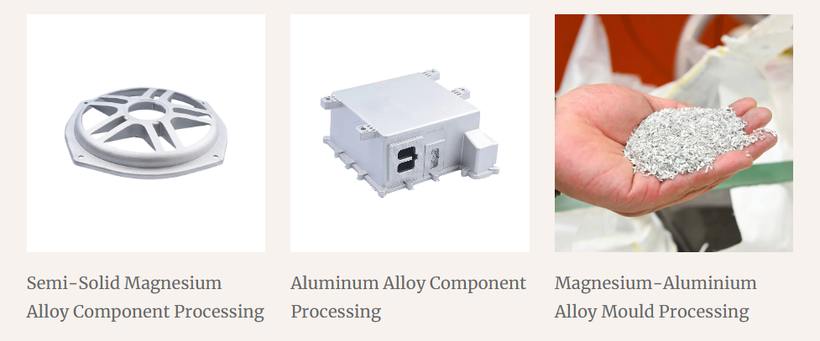
The three images below show representative outputs of this processing capability: a finished semi-solid magnesium alloy component, an aluminum alloy die cast enclosure, and raw magnesium-aluminium alloy material feedstock prepared for mould processing.
How Semi-Solid Magnesium Alloy Component Processing Works
Semi-solid magnesium alloy component processing is a metal forming technique in which magnesium alloy is heated to a temperature range between its solidus and liquidus points, producing a slurry-like structure containing both solid metal particles and liquid metal simultaneously. This partially solid state is then injected into a mould cavity under controlled pressure, a process that behaves differently from conventional die casting because the metal has higher viscosity and lower turbulence during mould filling. According to general metal forming engineering literature on thixomolding and semi-solid forming, this reduced turbulence during filling is one of the primary reasons semi-solid processed components tend to exhibit fewer internal gas pockets and lower porosity compared to components produced through fully liquid high-pressure die casting.
Lower porosity directly translates into improved mechanical properties, including better tensile strength consistency and reduced likelihood of micro-cracking under thermal or mechanical stress, which is particularly relevant for magnesium alloy components used in structural or load-bearing appliance parts such as speaker frames, brackets, and housing components. Semi-solid magnesium alloy component processing also allows thinner wall sections to be formed reliably compared to conventional casting, supporting lightweight design goals increasingly emphasized across household appliance and automotive component manufacturing.
Semi-solid slurry formation: magnesium alloy is heated to a partially solid, partially liquid state.
Controlled mould injection: the slurry is injected with reduced turbulence compared to liquid die casting.
Reduced porosity: fewer trapped gas pockets improve mechanical consistency across production batches.
Thin-wall capability: supports lightweight component design without compromising structural integrity.
Semi-Solid Magnesium Processing vs Standard Aluminum Alloy Component Processing
Choosing between semi-solid magnesium alloy component processing and standard aluminum alloy component processing depends primarily on target part weight, mechanical load requirements, and thermal performance needs for the finished appliance or industrial component. Magnesium alloy is significantly lighter than aluminum alloy at comparable volume, generally offering meaningful weight reduction for handheld or mobile appliance components, while aluminum alloy component processing remains widely favored for parts requiring higher general corrosion resistance and broader alloy formulation availability across established die casting supply chains.
General comparison of semi-solid magnesium alloy processing and standard aluminum alloy component processing
Attribute
Semi-Solid Magnesium Alloy
Aluminum Alloy Die Casting
Relative weight
Lighter
Moderate
Porosity control
Lower porosity via semi-solid forming
Moderate, process-dependent
Thin-wall capability
Strong
Good
Common applications
Lightweight brackets, speaker frames, housings
Enclosures, structural housings, heat sinks
The radar chart below compares semi-solid magnesium alloy processing and standard aluminum alloy component processing across five practical selection criteria relevant to component sourcing decisions. This visualization is intended to summarize general process characteristics rather than provide precise laboratory measurements for any specific part geometry. It is useful for appliance manufacturers and industrial buyers deciding which alloy processing route best fits a planned component design. Reading the chart from center outward, a larger shaded area along any axis indicates a stronger relative characteristic for that processing method. The five axes shown are weight reduction, porosity control, thin-wall capability, corrosion resistance, and dimensional stability, all factors influencing final component performance.
As the chart illustrates, semi-solid magnesium alloy processing extends further along the weight reduction, porosity control, and thin-wall capability axes than standard aluminum alloy die casting, reflecting the inherent low density of magnesium alloy combined with the reduced turbulence advantage of semi-solid forming during mould filling. Weight reduction is one of the most consistently cited benefits of magnesium alloy processing across engineering literature, since magnesium is meaningfully lighter than aluminum at equivalent volume, making it attractive for portable appliance components such as handheld device housings and speaker frame structures where reduced overall product weight is a design priority. Porosity control favors the semi-solid method specifically because the partially solid slurry state limits the turbulent flow that typically introduces trapped gas pockets during fully liquid die casting, a mechanism widely discussed in metal forming process literature covering thixomolding and rheocasting techniques. Thin-wall capability is strong for both processes but tends to favor semi-solid magnesium slightly further due to the improved flow characteristics of the semi-solid slurry through narrow mould sections. Corrosion resistance, by contrast, favors aluminum alloy component processing, since aluminum generally forms a more stable natural oxide layer across a wider range of environmental exposure conditions, which is why aluminum remains a common choice for enclosures and housings exposed to humidity or outdoor conditions. Dimensional stability is comparably strong for both processes when properly executed, though magnesium alloy components benefit further from the reduced shrinkage variability associated with semi-solid forming. For appliance manufacturers and industrial component buyers evaluating magnesium-aluminium alloy mould and parts processing options, this comparison suggests that semi-solid magnesium alloy processing is particularly well suited to lightweight, precision components such as speaker frames and mounting brackets, while aluminum alloy component processing remains a strong choice for structural enclosures and components requiring broader corrosion resistance. Many manufacturers ultimately specify both processes within a single product line, using magnesium alloy components where weight reduction is the primary design driver and aluminum alloy components where enclosure durability and thermal dissipation are prioritized. Buyers sourcing magnesium-aluminium alloy mould and parts processing capability should request specific process qualification data from suppliers, since porosity control and dimensional consistency vary meaningfully depending on mould design, injection parameters, and alloy formulation. This type of process-level comparison is consistent with general metal forming sourcing guidance that recommends matching alloy processing method to functional part requirements rather than selecting a process based on general familiarity alone.
Mould Design Considerations for Magnesium-Aluminium Alloy Parts Processing
Mould design plays a decisive role in the success of magnesium-aluminium alloy mould and parts processing, since gate placement, cooling channel layout, and venting design directly affect how completely the semi-solid or liquid alloy fills complex part geometry without trapping air or forming cold-flow defects. Mould materials used for magnesium and aluminum alloy processing are typically hardened tool steel grades selected for thermal fatigue resistance, since repeated exposure to molten or semi-solid metal at elevated temperature places significant cyclic thermal stress on the mould cavity surface over an extended production run.
The bar chart below presents a general illustration of relative mould design priority areas commonly emphasized across magnesium-aluminium alloy mould and parts processing projects, based on widely referenced die casting mould engineering considerations. This chart is intended as a directional reference for engineering discussion rather than a precise weighting for any single mould project. It is useful for component buyers and mould engineers understanding which design factors most influence part quality outcomes. The horizontal bars represent relative engineering emphasis typically placed on each design consideration, and longer bars indicate areas commonly treated as higher priority during mould development.
This chart reflects a pattern broadly consistent with die casting mould engineering guidance, where gate and runner design is typically treated as the highest priority consideration because it directly controls how the semi-solid or liquid alloy enters and fills the cavity, influencing flow pattern, fill time, and the likelihood of cold shut defects in the finished part. Cooling channel layout ranks closely behind, since uneven cooling across a mould cavity can produce warping, residual stress, or dimensional variation between production cycles, making conformal or well-balanced cooling channel design a significant engineering focus for magnesium-aluminium alloy mould and parts processing. Venting design addresses the practical need to allow trapped air and gas to escape the cavity during fill, and inadequate venting is a commonly cited cause of porosity defects even when gate design and alloy quality are otherwise well controlled. Tool steel selection, while ranking somewhat lower in this general emphasis chart, remains an important long-term consideration because mould life and dimensional consistency across thousands of production cycles depend heavily on the steel's resistance to thermal fatigue cracking and erosion from repeated molten metal contact. These four design considerations interact closely in practice, since a well-designed gate and runner system reduces stress on downstream cooling and venting requirements, while robust tool steel selection extends the productive life of a mould designed with strong flow characteristics. For manufacturers offering magnesium-aluminium alloy mould and parts processing services, maintaining engineering expertise across all four of these design areas is what typically distinguishes consistent, low-defect production from processes prone to recurring quality issues. Buyers evaluating a mould and component processing supplier should ask about mould design review practices, including simulation or trial-shot validation processes used to confirm gate, cooling, and venting performance before committing to full production tooling. This mould design emphasis is consistent with general die casting engineering literature that identifies gate design and thermal management as the most influential variables in achieving consistent part quality across high-volume magnesium and aluminum alloy production. Ultimately, strong mould engineering practice across these prioritized areas supports the dimensional consistency and low-defect rates that appliance and industrial component buyers expect from a reliable magnesium-aluminium alloy processing partner.
Application Trends for Lightweight Alloy Components in Appliance Manufacturing
Demand for lightweight magnesium and aluminum alloy components across household appliance manufacturing has grown steadily as product designers pursue reduced overall device weight, improved thermal management, and more compact form factors. This trend is consistent with broader industrial design commentary noting that consumer expectations for portable, lightweight electronics and small appliances have pushed component engineers toward increasing use of engineered alloy parts in place of heavier steel or thicker plastic structural components.
The area chart below presents a general illustrative trend showing how relative adoption of magnesium and aluminum alloy structural components in appliance product lines has increased over a multi-year period, based on commonly cited lightweight materials adoption patterns discussed across manufacturing industry commentary. The exact figures are illustrative of a general upward trend rather than a precise market statistic, and readers evaluating a specific product category should consult current supplier and industry data for precise figures. This chart is useful for appliance manufacturers considering whether to increase magnesium-aluminium alloy component usage in upcoming product designs. The horizontal axis represents time across a general multi-year progression, while the vertical axis represents relative adoption share within appliance structural components.
The upward trajectory of this area chart reflects a broader shift in appliance and electronics product design toward lightweight structural materials, a trend widely discussed across manufacturing and industrial design commentary covering consumer electronics and small appliance categories. One driver behind this trend is the growing emphasis on portable and countertop appliance categories, including coffee machines, waffle makers, and personal care devices, where reduced product weight directly improves perceived product quality and ease of handling for end users. Another driver is the improving cost efficiency and process maturity of semi-solid magnesium alloy component processing itself, which has made magnesium alloy parts more accessible for mid-volume production runs that previously relied primarily on plastic or steel components. As appliance designers increasingly specify internal structural brackets, speaker frames, and mounting components in magnesium or aluminum alloy rather than heavier alternatives, manufacturers offering integrated magnesium-aluminium alloy mould and parts processing capability are positioned to support this design direction without requiring appliance brands to coordinate across multiple separate material suppliers. This trend also intersects with thermal management priorities, since aluminum alloy in particular offers favorable heat dissipation characteristics that support compact electronic and heating appliance designs where component density has increased alongside miniaturization efforts. For component manufacturers, this generational shift supports continued investment in both semi-solid magnesium alloy processing and standard aluminum alloy die casting capability, since appliance brands increasingly specify a combination of both material types within a single product depending on which components carry structural load versus which require corrosion resistance or thermal performance. Buyers developing new appliance product lines should consider engaging alloy component processing partners early in the design phase, since mould and part geometry decisions made during initial product development significantly influence downstream manufacturing feasibility and part quality. This adoption trend, consistent with broader lightweight materials commentary across manufacturing industry sources, reinforces why magnesium-aluminium alloy mould and parts processing capability has become an increasingly relevant differentiator for appliance component manufacturers supporting international brand customers.
Isometric View of a Magnesium Alloy Component Mould Cavity
The schematic diagram below illustrates an isometric view of a typical mould cavity used in magnesium-aluminium alloy mould and parts processing, highlighting the gate entry point, cavity fill pattern, and cooling channel positioning relevant to producing a component such as the speaker frame shown in the earlier product image. Understanding this general mould cavity layout helps clarify why gate placement and cooling channel positioning are treated as primary engineering variables in achieving consistent part quality across production cycles.
This isometric schematic is useful for engineers and buyers evaluating magnesium-aluminium alloy mould and parts processing proposals, since the relative position of the gate entry point to the overall cavity geometry directly affects fill balance across complex geometries such as the ribbed speaker frame design shown earlier in this article. A well-positioned gate reduces the distance the semi-solid alloy must travel to reach the furthest cavity extremities, lowering the risk of premature solidification before the mould is fully filled, a defect commonly referred to as a short shot in die casting and semi-solid forming literature. Cooling channel positioning around the cavity periphery supports even heat extraction across the part, which helps minimize warping and residual stress that could otherwise affect the dimensional accuracy of finished magnesium alloy components. This type of mould cavity analysis is a standard part of engineering review processes used by experienced magnesium-aluminium alloy mould and parts processing manufacturers before committing to full production tooling.
Company Capability in Alloy Component and Mould Processing
Ningbo Victor Electrical Technology Co., Ltd., operating under Victor Electric Appliance Technology Co., Ltd., specializes in the research, development, and manufacturing of kitchen appliances, dedicated to delivering convenient, efficient, and intelligent solutions for modern households worldwide. Since its establishment in 2019, Victor has focused on product innovation and continuous expansion across key segments such as coffee machines, waffle makers, smokeless grill pans, and steam cookers, and this product development work is supported internally by magnesium-aluminium alloy mould and parts processing capability, including semi-solid magnesium alloy component processing and aluminum alloy component processing used to manufacture structural brackets, housings, and precision components such as the semi-solid magnesium alloy speaker frame and aluminum alloy enclosure shown earlier in this article. With a growing portfolio of self-developed models, the company has built a strong product lineup and expanding presence in international markets. Guided by the values of integrity, responsibility, and win-win collaboration, Victor continues to enhance its manufacturing foundation, quality control system, and automation capabilities across both alloy component processing and finished appliance production.
Frequently Asked Questions
Q1: What is semi-solid magnesium alloy component processing? It is a metal forming method where magnesium alloy is heated to a partially solid, partially liquid state before mould injection, reducing porosity and improving mechanical consistency compared to fully liquid casting.
Q2: How does magnesium alloy processing compare to aluminum alloy component processing? Magnesium alloy is generally lighter and benefits more from semi-solid processing's porosity control, while aluminum alloy typically offers stronger general corrosion resistance for enclosures.
Q3: What mould design factors matter most for magnesium-aluminium alloy mould and parts processing? Gate and runner design, cooling channel layout, venting design, and tool steel selection are the primary engineering considerations affecting part quality and mould longevity.
Q4: Why are appliance manufacturers increasing use of magnesium and aluminum alloy components? Lightweight alloy components support reduced product weight, improved thermal management, and more compact designs favored across modern household appliance categories.



 中文简体
中文简体 English
 한국어
한국어 日本語
日本語 русский
 Español
 عربى
عربى