


 中文简体
 English
 한국어
 日本語
 русский
 Español
 عربى
Industry News
Home / News / Industry News / Coffee Syrup and Machine Compatibility: A Buyer's Guide for OEM Programs
Nov 23, 2026
Content
Two weeks after a café swaps bottled vanilla coffee syrup for a bag-in-box concentrate, the drinks start drifting. The first ten cups of the morning taste right, the afternoon ones arrive sweeter and thinner, and nobody behind the counter can explain why. The grinder has not moved. The beans have not changed. What changed is the fluid running through the dosing path: its viscosity at room temperature, its sugar concentration, and the way a pump calibrated for one product behaves when it is asked to move another.
Here is the short answer. Coffee syrup is a fluid-handling decision, not a pantry decision. Put dose volume, viscosity window, nozzle geometry and cleaning routine into the machine specification at the same time as the syrup format, and flavored drinks stay repeatable across a shift, a season and a container change. Leave it as an afterthought and the inconsistency will look like a machine fault even when the machine is doing exactly what it was built to do.
This guide is written for the people who actually carry that risk: product managers building a flavored beverage program, procurement teams comparing coffee machine suppliers, and brand owners preparing a brief for an ODM/OEM manufacturing partner. It covers dose math, packaging formats, compatibility failures, menu economics and the maintenance habits that keep a syrup line running clean.
In most projects the machine and the syrup are bought by two different people on two different days. The machine buyer compares tank volume, heating power, brew temperature stability and lead time. The syrup buyer compares flavor range, shelf life, sugar-free options and price per liter. Neither conversation includes the other, and that is precisely where flavored coffee programs lose consistency.
Four variables connect the two decisions, and they are worth agreeing before any purchase order is signed:
There is also a commercial argument. A manufacturer that already builds the brew system, the water path and the control board is in a far better position to integrate a dosing point than a buyer trying to bolt one on afterwards. Buyers who raise the syrup question during the request-for-quotation stage usually get a cleaner answer than those who raise it after the first production run.
A pump of syrup is not a neutral addition. It occupies volume, it carries sugar, and it dilutes the coffee that is already in the cup. A 12 oz (350 ml) latte built with 15 ml of syrup and 30 ml of espresso has roughly 4 percent of its volume taken up by syrup alone, and that volume has to come from somewhere: either the milk shrinks or the cup overflows.
The arithmetic is simple enough to do on a napkin. Most beverage syrups sit between 50 and 65 degrees Brix, which means a 10 ml dose delivers roughly 6.5 to 8.5 grams of sugar depending on density. That is meaningful sweetness, and it lands in a drink where the coffee solids, milk fat and acidity are all competing for the same attention. When a barista adds an extra half pump to compensate for a weak shot, the drink does not simply become sweeter; it becomes sweeter, thinner and less acidic at the same time.
A hot latte tolerates a two-pump dose because milk fat carries sweetness well. A cold brew is a different problem: cold extraction leaves more residual acidity and less bitterness, and syrup added at the same rate reads flatter and heavier. An Americano has no milk to soften the sugar load, so one pump is usually the ceiling before the drink stops tasting like coffee. Sugar-free coffee syrup adds a further wrinkle, because the body that sugar normally provides has to be replaced by something else or the drink finishes thin.
This is why brew strength and syrup dose should be tuned as a pair. If the extraction is running slightly under, the temptation is to add syrup; the better correction is to fix the grind or the dose of grounds and leave the syrup ratio where the recipe says it should be.
The chart below shows typical syrup volumes for five common drink styles, based on a standard 7.5 ml pump and the recipes most operators settle on after a short period of menu testing. The purpose is not to prescribe a recipe but to show how widely the draw varies across a single menu.
The spread matters far more than any single figure. A machine that will only ever serve hot americanos needs a dosing point sized for one pump, while a menu built around blended and iced drinks needs hardware that can deliver three or four pumps per cup without the operator standing over it. When buyers ask us to quote a coffee machine for a flavored program, the first question we return is which drink on the menu carries the most syrup, because that number sizes the pump, the reservoir and the cleaning interval all at once.
It also shapes the machine's water and heating budget. A blended drink pulls extra ice and extra liquid, so the brew side has to produce a concentrate strong enough to survive dilution rather than a full-strength cup. Drip filter machines with a larger brew basket and a keep-warm or shuttle arrangement are easier to fit into this pattern than a single-serve unit, because the operator can brew a concentrate batch and dose syrup to order. Multifunctional drip filter models with adjustable strength settings give the person behind the counter room to move without changing the machine.
The practical takeaway is that the highest-draw drink on the menu should define the hardware, not the average cup. Sizing for the average is how operators end up hand-pumping syrup into blended drinks at the busiest hour of the day.
The packaging a syrup arrives in determines how it is dosed, how long it stays fresh, and how much space the bar needs behind the counter. Each format carries its own machine-side requirements, and mixing formats within one program is usually a mistake unless the menu genuinely calls for it.
This is the default for cafés running four to six flavors. Bottles are easy to handle, easy to swap, and the pump gives the barista tactile feedback. The machine-side demand is modest but real: enough counter clearance for the pump head, a nozzle path wide enough that a 10 ml dose clears in one go, and a drip tray that can be lifted out for a rinse. The most common failure is pump drift after repeated refills, where the pump collar loosens and each stroke quietly delivers less than it should.
High-volume sites and chain programs lean toward bag-in-box because it removes the refill step and keeps the syrup sealed from air until the very end. The trade-off is plumbing: tubes, couplings and a dispenser head that has to be routed and secured. Air pockets in the line are the classic defect, producing a partly filled dose on the first cup after a box change. If a machine is designed to accept a bag-in-box feed, the coupling position and the tube path should be fixed in the tooling rather than improvised at installation.
Concentrated bases cut shipping weight and storage space, but they demand accurate low-volume dosing, often in the 3 to 6 ml range. A pump built for 10 ml strokes is the wrong tool: the operator will either under-dose and get a flat drink, or over-dose by a factor of two and produce something undrinkable. Concentrates suit projects where freight cost dominates and where the machine can be fitted with a fine-scale dosing point.
Powder is cheap to ship and stable at room temperature, and it works well in iced and takeaway formats where the drink is shaken or blended anyway. It does not dissolve cleanly in cold liquid without agitation, so a machine built around powder needs a mixing step, a dry hopper and a cleaning routine that deals with clumping at the dispenser throat.
| Format | Typical dose per 12 oz | Machine-side requirement | Most common failure | Best fit |
|---|---|---|---|---|
| Bottle with pump | 7.5 to 15 ml | Pump dock clearance, accessible nozzle, removable drip tray | Pump drift after repeated refills | Cafés running four to six flavors |
| Bag-in-box with dispenser | 10 to 20 ml | Fixed coupling position, secured tube path, sealed feed | Air pockets and kinked tubing | High-volume sites and chain programs |
| High-concentration base | 3 to 6 ml | Fine-scale dosing, accurate low-volume control | Over-dosing by two or three times | Freight-sensitive projects, compact machines |
| Powdered base | 8 to 12 g | Dry hopper, mixing agitation, wide dispenser throat | Clumping in cold liquid | Iced and takeaway-focused menus |
Whichever format is chosen, the decision should be made once and written down. Programs that mix formats usually end up with two sets of cleaning instructions, two dose charts and a staff training problem that never quite resolves.
Compatibility problems rarely show up in the first week. They appear after the machine has been in service long enough for temperature cycling, residue build-up and staff habits to take hold. These are the four that come up most often in flavored coffee service.
A syrup stored in a chilled cabinet thickens. If the dosing point runs on a fixed timer rather than a flow measurement, a colder syrup means a smaller dose in the same number of milliseconds. The drink gets subtly weaker as the day goes on and nobody notices until a customer comments. Machines that hold syrup at ambient temperature avoid the issue but need a shelf-life check to confirm the product tolerates it.
Any syrup left on a nozzle will dry. Once the water leaves, the sugar crystallizes into a hard plug that a quick wipe will not remove. A nozzle with a large internal cavity and a horizontal exit is a much better candidate than a narrow vertical tip, because the residue stays accessible. A daily warm-water flush costs almost nothing and prevents most of it.
Sugar solutions, acids and preservatives each attack elastomers differently. A gasket that performs perfectly on water may swell or harden after a month of contact with an acidic fruit-flavored syrup. Any wetted part that touches syrup should be specified against the actual product range, not against water alone. Silicone and EPDM behave very differently here, and the choice belongs in the drawing, not in the spare parts bin.
Some syrups foam when they hit hot milk, particularly those with high protein or certain stabilizer systems. A little foam is fine in a latte; a lot of foam in a machine with a narrow milk line is a blockage waiting to happen. If a syrup-based signature drink is going to run through an automatic milk system, test it on that system before committing to the recipe.
Two cafés can use the same machine and the same coffee syrup supplier and still produce noticeably different drinks, because dose control lives in the routine rather than the hardware. The target is not perfection; it is a tolerance tight enough that a customer cannot detect the variation between one cup and the next.
For a 12 oz drink, a working tolerance of plus or minus 0.5 ml per serve is realistic and adequate. That is roughly five percent of a two-pump dose, which sits below the threshold most drinkers can reliably detect. Achieving it needs three things:
Where the machine supports timed dosing, the timer value should be recorded on the recipe card next to the flavor name, not left in a technician's notebook. Where dosing is manual, the pump itself is the measuring instrument and should be treated as one: cleaned, checked and replaced on a schedule rather than when it finally fails.
The most common menu mistake is breadth. A café launches with fifteen flavors, discovers that six of them move fewer than five servings a week, and ends up with a shelf of half-used bottles slowly going out of date. A tighter menu with better execution almost always outperforms a wide one.
Vanilla, caramel, hazelnut and chocolate do most of the work in most markets, and they are the four a customer expects to find. Add one seasonal rotation and one sugar-free option and the menu covers the overwhelming majority of orders. Everything beyond that is a differentiator that has to earn its shelf space with a specific signature drink.
Opened syrup does not last indefinitely. Many products are specified for one to three months once opened and refrigerated, and a slow-moving flavor will expire before it is half used. Multiply the weekly servings by the weeks of shelf life and compare that to the bottle size; if the numbers do not work, buy a smaller pack rather than a bigger shelf.
A flavor that appears only in a modifier list rarely sells. A flavor attached to a named drink, with a photo and a price, sells. This is also where machine capability pays off: a program with a crushed-ice option or a reliable cold-brew base can build drinks that a hot-only machine cannot, and those drinks justify the extra flavors on the shelf.
Cold drinks change the syrup equation in two ways. First, ice dilutes the drink as it melts, so a recipe balanced at the moment of service drifts sweeter and weaker over ten minutes. Second, the syrup has to be in the cup before the ice goes in, or it sits at the bottom and the first sip is a different drink from the last.
The practical fix is to build the drink in a fixed order: syrup, then coffee concentrate, then milk or water, then ice. The syrup dissolves into the liquid phase instead of clinging to the ice, and the dilution happens evenly. For blended drinks the same logic applies, with the syrup going in before the ice so the blade has something to carry it through the whole cup.
A machine built for this kind of service needs a brew side strong enough to survive dilution and a control layout that lets the operator dose before adding ice. Combination machines that pair a brew module with an ice-handling function reduce the number of steps in the sequence, which is where most cold-drink inconsistency comes from in the first place.
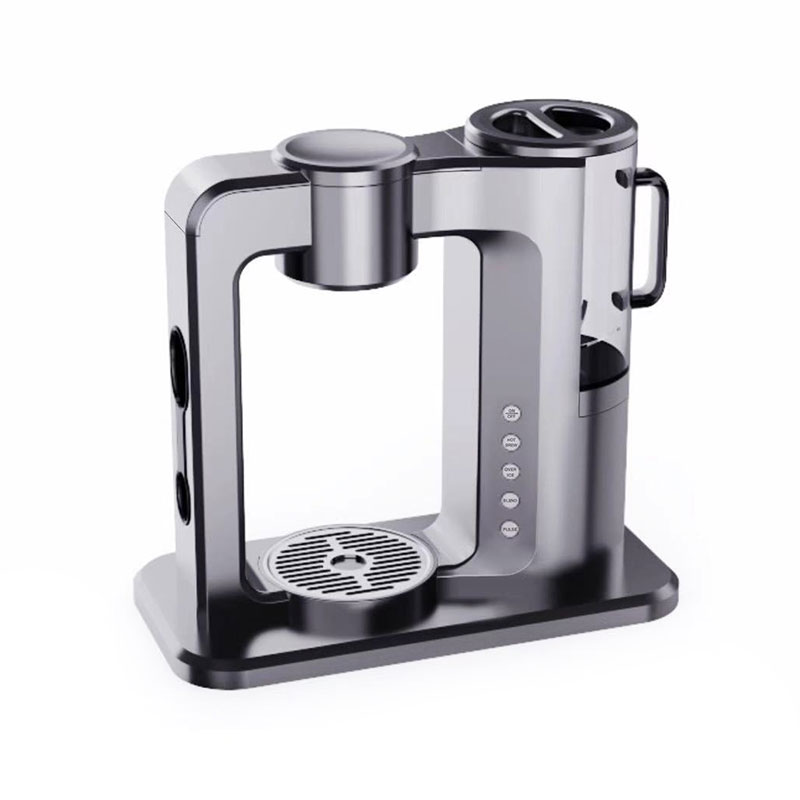 Crushed Ice Combination Coffee Machine with Built-In GrinderCombines grinding, hot extraction, and ice crushing for hot and iced drinks, reducing separate equipment and supporting a simpler dose-before-ice workflow.View Product →
When a project involves both hot and cold flavored drinks, the cold side usually sets the requirement for the whole machine: cooling capacity, reservoir size, and the physical room to dose syrup before ice. Getting that sequence right at the design stage removes a whole category of training problems later.
Once a flavored program reaches a few hundred cups a day, the bottleneck stops being the barista and starts being the batch. A large tank that brews well but sits behind an undersized dosing point simply moves the queue rather than clearing it. Volume planning has to consider brew cycle time, holding time and syrup draw rate as one system.
Large-capacity drip filter machines suit this pattern because they allow a concentrate batch to be brewed ahead and held while drinks are assembled to order. The operator doses syrup, adds the concentrate, finishes with milk or water, and the whole sequence takes less time than a single-serve brew. The design detail that matters most is temperature stability during holding: a concentrate that sits too warm for too long develops a flat, stewed character that no amount of syrup will rescue.
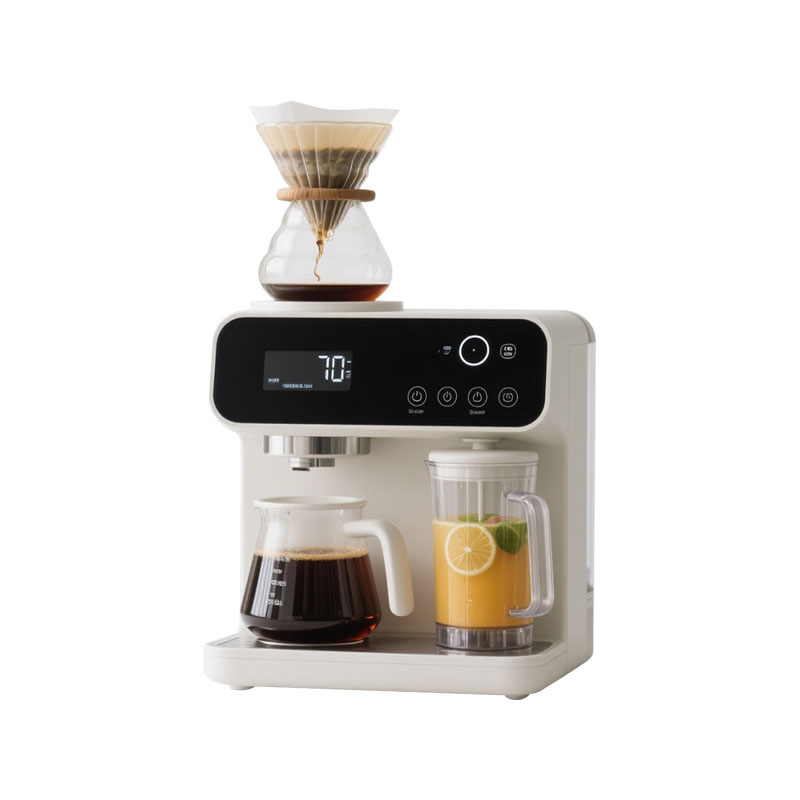 Large-Capacity Drip Filter Coffee Machine for Batch BrewingBrews up to 12 cups with a 1.8L tank, programmable scheduling, and 2-hour keep-warm, suited to holding concentrate for assembled drinks.View Product →
For buyers sourcing from a manufacturer like Victor Electric Appliance Technology Co., Ltd., the operational numbers matter as much as the specification sheet. An average delivery time of around 45 days and an export share of roughly 60 percent mean that production planning has to be locked early, particularly when the syrup format is still being finalized. A program that changes its bag-in-box coupling after the tooling is approved will lose far more than the four to six weeks a stable brief would have cost.
The table below is a working checklist rather than a standard. The tolerances are the ones that hold up in typical café service; a high-volume program may tighten them further, and a small office installation may loosen them. What matters is that each line is written down and agreed by both the machine supplier and the syrup supplier before first article approval.
| Specification area | What to state in the brief | Suggested tolerance | Why it matters |
|---|---|---|---|
| Dose volume per serve | Target millilitres for each menu item | Plus or minus 0.5 ml per 12 oz | Keeps sweetness consistent between shifts |
| Viscosity window | Expected range at working temperature | Stated in centipoise at 20 degrees Celsius | Drives pump type and timer values |
| Sugar content | Degrees Brix of the products in scope | Plus or minus 2 Brix | Affects body and perceived sweetness |
| Storage temperature | Chilled, ambient, or both | 4 to 25 degrees Celsius | Controls crystallization and dose drift |
| Cleaning interval | Daily flush and weekly deep clean | Documented in the manual | Prevents nozzle plugging and odor |
| Packaging interface | Bottle neck size or bag-in-box coupler | Dimensional drawing attached | Avoids leaks and air pockets |
Two of these lines cause more disputes than the rest combined: the viscosity window and the packaging interface. Both are easy to leave vague and both are expensive to correct once tooling exists. A syrup supplier who can provide a technical data sheet with viscosity, Brix and pH is worth more than one who can only provide a flavor list.
The liquid cost of syrup per cup is usually smaller than operators expect, which is why it is a poor place to look for savings. A worked example makes the point without pretending to know local pricing.
Suppose a 12 oz flavored latte carries 15 ml of syrup, and a one-liter bottle costs whatever your supplier charges. One liter contains roughly 66 doses at that volume, so the per-cup cost is the bottle price divided by 66. Even at a relatively high bottle price, the syrup contribution stays in the same range as the milk. The costs that actually move the margin are elsewhere:
Frame the business case around remakes and waste rather than around the bottle price. A program that cuts remakes by a few cups a day pays for a better dosing setup long before it pays for itself on syrup alone.
Sugar residue left overnight is the single largest cause of blocked dosing lines in flavored coffee service. It is also the easiest problem to prevent, provided the cleaning routine is designed around the machine rather than added to it afterwards.
Milk systems need their own schedule. A machine that runs dairy through the same area as syrup will build up a combined residue that is harder to remove than either alone, and the cleaning agent that shifts sugar is not always the one that shifts fat. Where the machine has an automatic rinse function, confirm that it covers the dosing path and not just the brew group.
The design side of this is straightforward: give the operator a removable, accessible part and they will clean it. Seal it behind a panel held by four screws and they will not. Buyers evaluating machines for a flavored program should ask to see the cleaning procedure, not just the cleaning claim.
Brand owners preparing a private-label or custom machine program have one advantage over buyers shopping from a catalogue: they can specify the syrup interface before the tooling exists. That advantage disappears quickly if the syrup decision is deferred to the end of the project.
A workable brief covers five items. The syrup format and packaging dimensions. The maximum and minimum dose per serve. The expected viscosity and Brix range across the flavor portfolio. The cleaning method and how accessible the dosing path needs to be. And the regulatory and labeling requirements for the destination markets.
These items feed directly into the parts of the machine that take the longest to change: housing layout, nozzle geometry, control firmware and the wetted material selection. A manufacturer with in-house mould and metal part capability can move faster on those changes than one sourcing everything externally, but even then a late change is a late change.
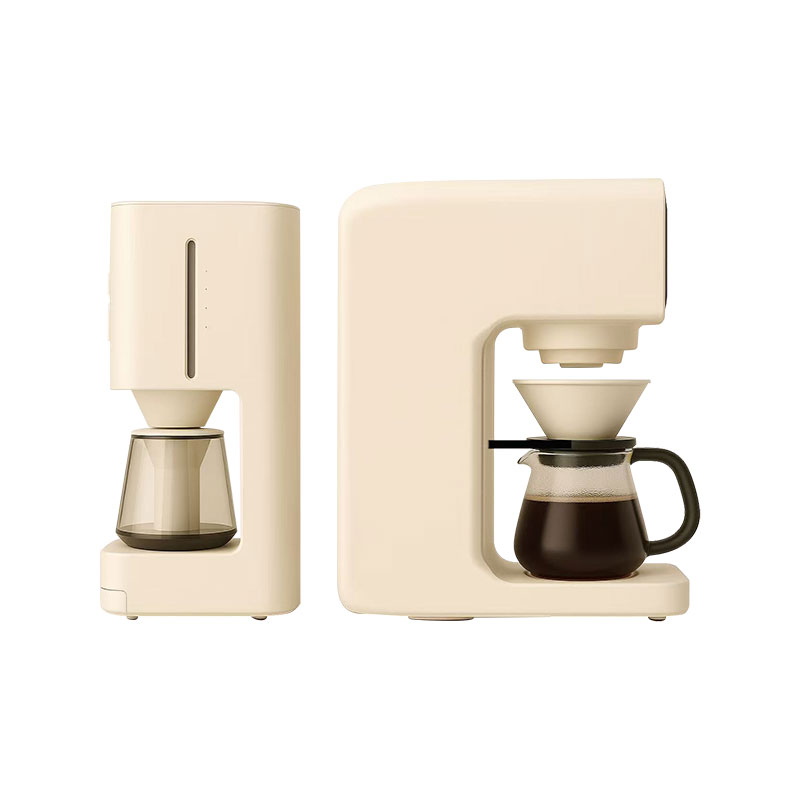 Household and Commercial Combination Coffee Machine with Three Brewing ModesOffers one-touch, creative, and free modes with adjustable extraction settings, plus self-cleaning and removable components for home or commercial use.View Product →
Testing is where a well-written brief earns its keep. A machine destined for flavored service should be run through temperature and humidity cycling, life testing on the pump or dosing mechanism, and a residue test after the cleaning cycle to confirm nothing is left in the line. Victor Electric Appliance Technology Co., Ltd. maintains a testing facility covering environmental chambers, life testing systems and material checks, which means these questions can be answered with data rather than assurances. Buyers evaluating any coffee machine manufacturer should ask which of those tests will be applied to the dosing path specifically, because that is the part most often left out of a standard test plan.
Finally, build in a first-article approval step that uses real syrup, not water. A pump that meters water accurately can still fail on a 60 Brix product, and the difference only appears when the actual fluid is in the line.
It depends on the product. Many syrups are specified for one to three months at ambient temperature once opened, while others require chilling to hold quality. The storage condition affects dose behavior as well as shelf life, because a chilled syrup is thicker and a timer-based pump will deliver less of it. Check the supplier's data sheet and match it to the machine's storage arrangement.
Two standard pumps, roughly 15 ml, is the common starting point for a hot latte. Iced and blended drinks usually need more because ice and dilution mute the flavor. Whatever the recipe, fix the number in writing and check it on a scale at the start of each shift.
Usually not without a recalibration. Sugar-free products often have a different viscosity and a different mouthfeel at the same dose, so the pump may deliver a similar volume but the drink tastes thinner. Some operations run a separate, clearly marked pump for sugar-free to avoid cross-contact and confusion.
Not the brew path, if the machine is cleaned on schedule. The risk sits in the dosing line and nozzle, where dried sugar can crystallize into a hard plug. A warm-water flush at the end of each shift and a weekly soak of the removable parts prevent almost all of it.
Before, in most recipes. Syrup in the cup first lets the hot espresso dissolve and mix it as it pours, which gives a more even drink than stirring syrup into a finished cup. For iced drinks the same order applies, with ice added last.
Syrups are thinner, pump more easily and disperse into liquid quickly, which suits hot and iced drinks alike. Sauces are thicker and are typically used where a heavier body or a drizzle is wanted. A machine set up for syrup will need a different dosing approach if sauces are added to the menu later.
Four to six covers most demand: vanilla, caramel, hazelnut, chocolate, plus one seasonal and one sugar-free. More than that usually means slow-moving stock that expires before it is used, which costs more than the extra menu variety earns.
They can. If the menu leans on blended or iced drinks, the machine needs enough brew strength to survive dilution, enough capacity to keep up with the busiest hour, and a dosing arrangement that can handle the highest pour on the menu. Buyers who specify the syrup program alongside the machine usually end up with a simpler configuration than those who retrofit one afterwards.
If you are planning a flavored coffee program, the useful next step is not a flavor list but a specification. Write down the format, the maximum dose, the viscosity range and the cleaning routine, then take those four items to the machine side of the project and see what changes. In most cases the answer is a small adjustment made early rather than a redesign made late.
Related resources from our factory
Flavored drinks are one of the few places in coffee service where the machine and the ingredient genuinely have to be designed around each other. Get that relationship right at the specification stage and the rest of the program, from training to costing, becomes considerably easier to manage.
Follow our social media to learn more about our updates


+86-13805815092

No. 11 Beihai Road, Xinqi Street, Beilun District, Ningbo City, Zhejiang Province, China
